
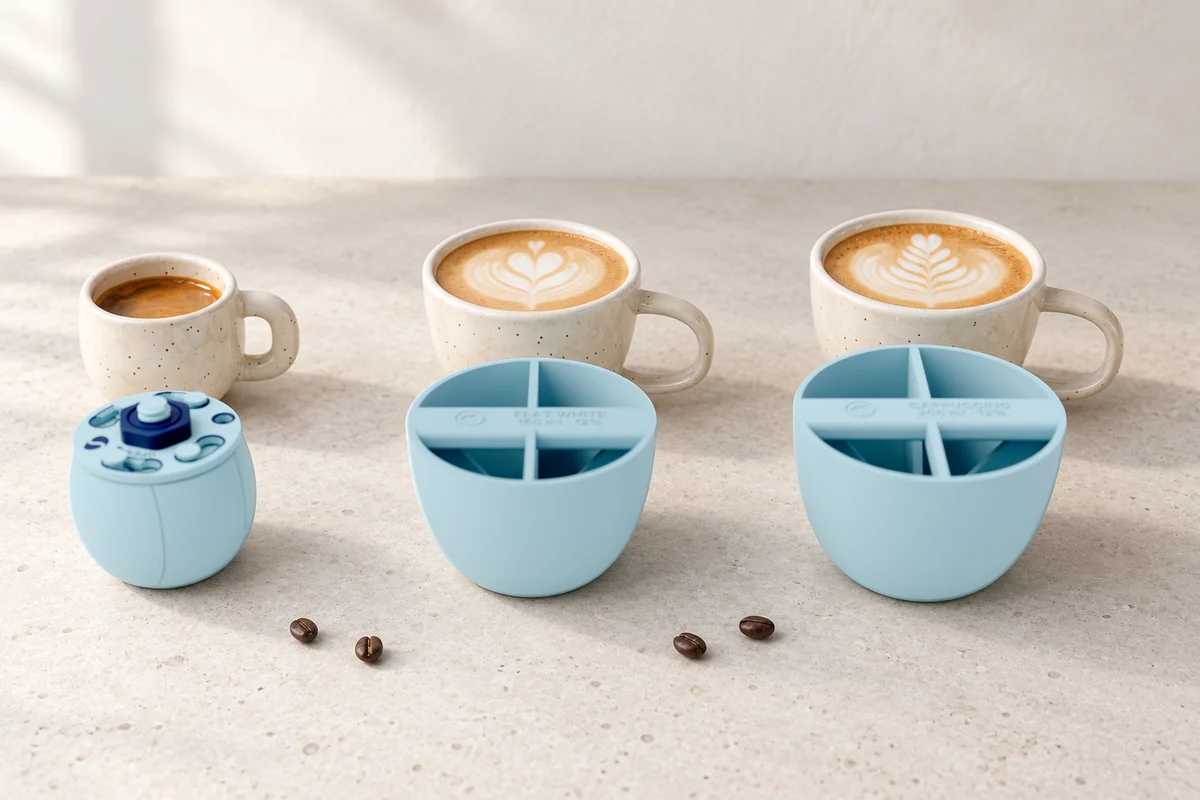
In the references we cite below, an espresso cup holds 50 to 100 mL, a flat white cup 150 to 180 mL, and a traditional cappuccino takes up 150 to 180 mL. SenseCraft’s Barista Line follows the same logic: 3D-printed molds that form the interior of slab-built ceramic cups, one for each drink — Espresso 80, Flat White 160 and Cappuccino 200, holding 80, 160 and 200 mL to the brim.
This article explains what each drink is, why each cup has its profile and measurements, and what that changes in the mold. The numbers come from our design studies and the CAD; whatever has not been tested yet is stated in the text.
One cup for each drink
All three drinks start from espresso. What changes is how much milk goes in, how much foam sits on top and, therefore, how much room the cup needs.
| Cup | Drink | Capacity to the brim | Serving planned in the study | Rim × height (interior) | Flat base | Mold |
|---|---|---|---|---|---|---|
| Espresso 80 | Espresso, single or double | 80 mL | 30–50 mL | Ø48 × 41 mm (belly Ø54) | Ø34 mm | Collapsible (Hold-All) |
| Flat White 160 | Flat white | 160 mL | 140–150 mL | Ø72 × 49 mm | Ø34 mm | Rigid, one piece |
| Cappuccino 200 | Cappuccino | 200 mL | 170–180 mL | Ø78 × 52 mm | Ø38 mm | Rigid, one piece |
Cup interior measurements after firing (FIRED), with 12% reference shrinkage.
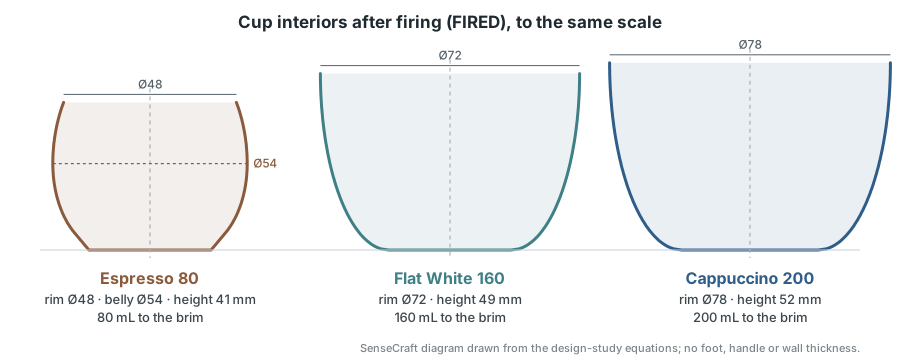
The three interior profiles to the same scale, drawn from the equations in the studies. SenseCraft teaching diagram, with no foot, handle or wall thickness.
Why “to the brim”?
In the Barista Line studies, the stated capacity is the geometric volume up to the plane of the rim. This convention makes the three cups comparable. Nobody serves that way, so each study separates capacity (to the brim) from serving (the planned volume of drink, which is smaller).
What each drink is
Espresso cup size: how many mL should it hold?
Espresso is a concentrated coffee made by forcing hot water under pressure through finely ground coffee. The Istituto Nazionale Espresso Italiano defines its certified espresso with 7 g of coffee, water at about 88 °C, 9 bar, 25 seconds of extraction and 25 mL in the cup, crema included — the fine golden foam that covers an espresso. The institute’s reference cup is white porcelain, 50 to 100 mL. Outside Italy, many cafés serve a double shot of around 50 mL.

Crema on an espresso. Photo: HSwaff, CC BY-SA 4.0, via Wikimedia Commons; resized and converted to WebP.

Flat white: espresso with a little microfoam
A flat white is espresso, usually a double, with steamed milk and a thin layer of microfoam, about 5 mm according to the description cited by Wikipedia. Its origin is disputed between Australia and New Zealand. Compared with a latte, it has less milk and a stronger coffee taste. Baristas interviewed by Perfect Daily Grind mention 5 to 6 oz cups (about 150 to 180 mL); Wikipedia records 175 mL as common in New Zealand and up to 200 mL in Australia.
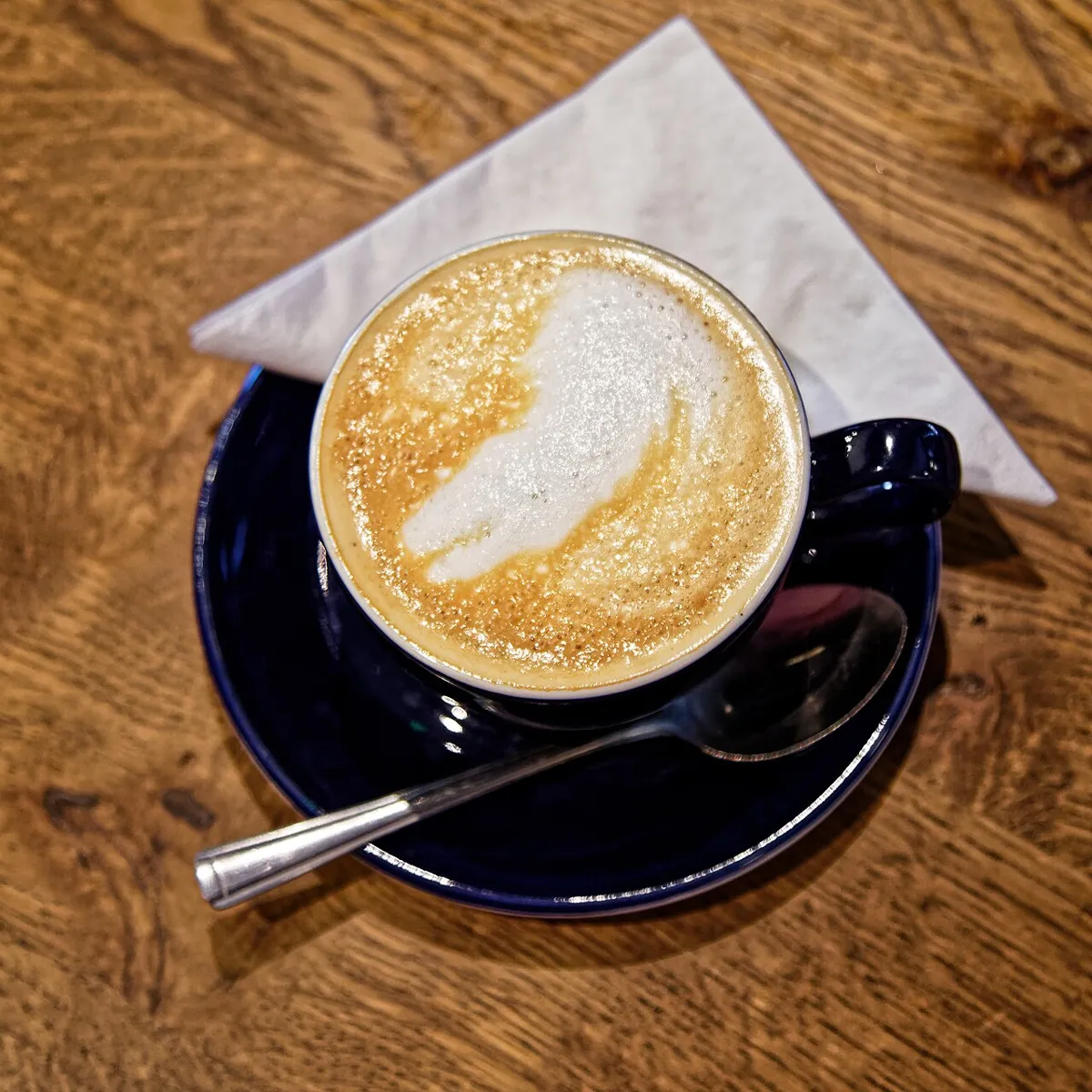
A flat white served in a cup with a saucer. Photo: Acabashi, CC BY-SA 4.0, via Wikimedia Commons; resized and converted to WebP.

Cappuccino: what size is the cup?
A cappuccino is espresso with steamed milk and a thicker layer of foam on top. The institute’s certified Italian cappuccino uses 25 mL of espresso and 100 mL of milk, with the steamed milk reaching approximately 125 mL, for a total beverage volume of around 150 mL, in a 150 to 160 mL cup. Wikipedia gives 150 to 180 mL of drink as the usual size in Europe and the United States. Until 2015, the World Barista Championship included the cappuccino as a set course, served in a 150 to 180 mL cup, and the rules required at least 1 cm of foam for a score of 4 or more on foam consistency and persistence; since 2016 the competition has used a broader milk beverage category.

A cappuccino with latte art. Photo: Kgbo, CC BY-SA 4.0, via Wikimedia Commons; resized and converted to WebP.

What is the difference between a flat white and a cappuccino?
Both have espresso and steamed milk. The flat white has a thin layer of microfoam and usually more coffee relative to milk; the cappuccino has taller foam and so needs more room above the liquid. In the Barista Line, this difference led to a smaller cup for the flat white and a larger cup with a wider rim for the cappuccino. The wider rim gives a larger surface, but we have not yet tested whether that brings any advantage when preparing the drink.
Espresso 80: why the rim is narrower than the belly
80 mL to the brim. A 30 to 50 mL serving sits between about 14 and 23 mm below the rim: there is room for the crema and for carrying the cup without spilling.
Tulip interior. The rim (Ø48 mm) is slightly narrower than the widest point (Ø54 mm, 24 mm above the base): the belly is 12.5% wider than the opening. The idea comes from a 2018 study by Carvalho and Spence with 276 participants, in which tulip-shaped vessels received higher aroma-intensity ratings than open ones. The study used filter coffee, not espresso, and did not define ideal measurements, so we treat the tulip as a design hypothesis, not a proven benefit. The narrowing was kept small to preserve access for drinking, stirring and cleaning.
Interior height of 41 mm, to keep the cup compact.
Flat base of about Ø34 mm, joined to the wall by a curve, with no inside corner. The original study called for Ø24 mm. In October 2026 the base was widened with a 50° conical section: below 45°, the surface that forms the base overhung during printing and the first layers came out rough. The capacity stays close to 80 mL and the difference in the cup is hard to see.
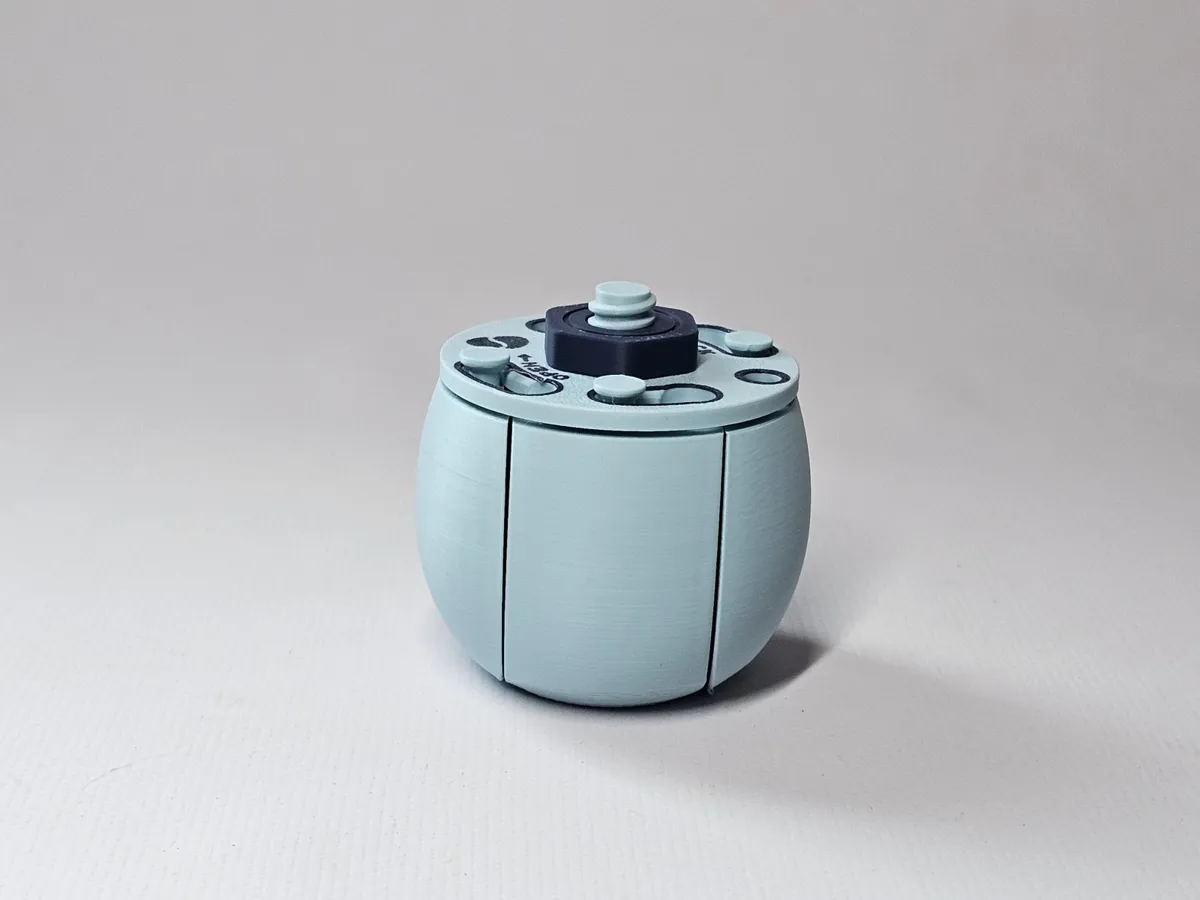
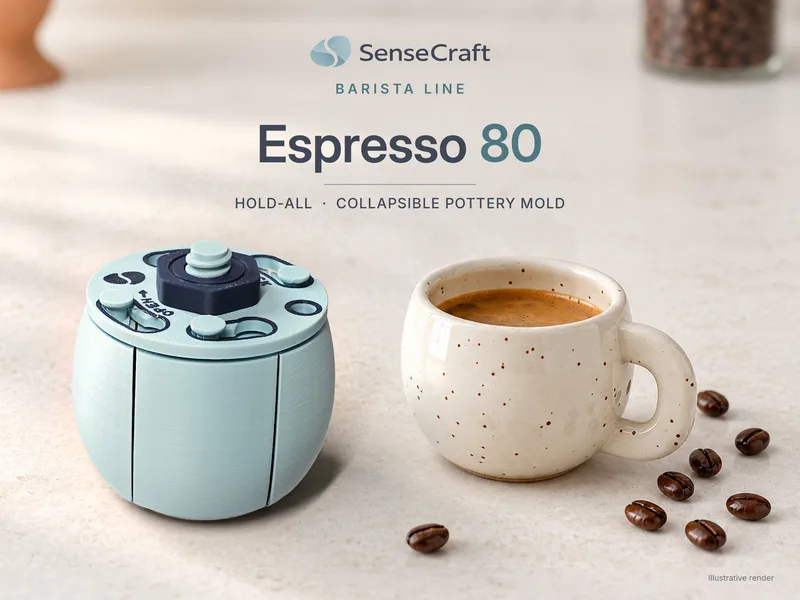
The assembled Espresso 80: the clay slab goes over the outside of this body, which shapes the interior of the cup.
That is why the mold comes apart. Since the widest point is below the rim, a one-piece mold would be trapped inside the cup. The Espresso 80 uses the Hold-All collapsible system: loosen the nut, turn the lid to open it, remove the core, and the segments fold toward the center and come out one by one through the rim. The guide to pottery without a wheel shows when a collapsible mold is needed.
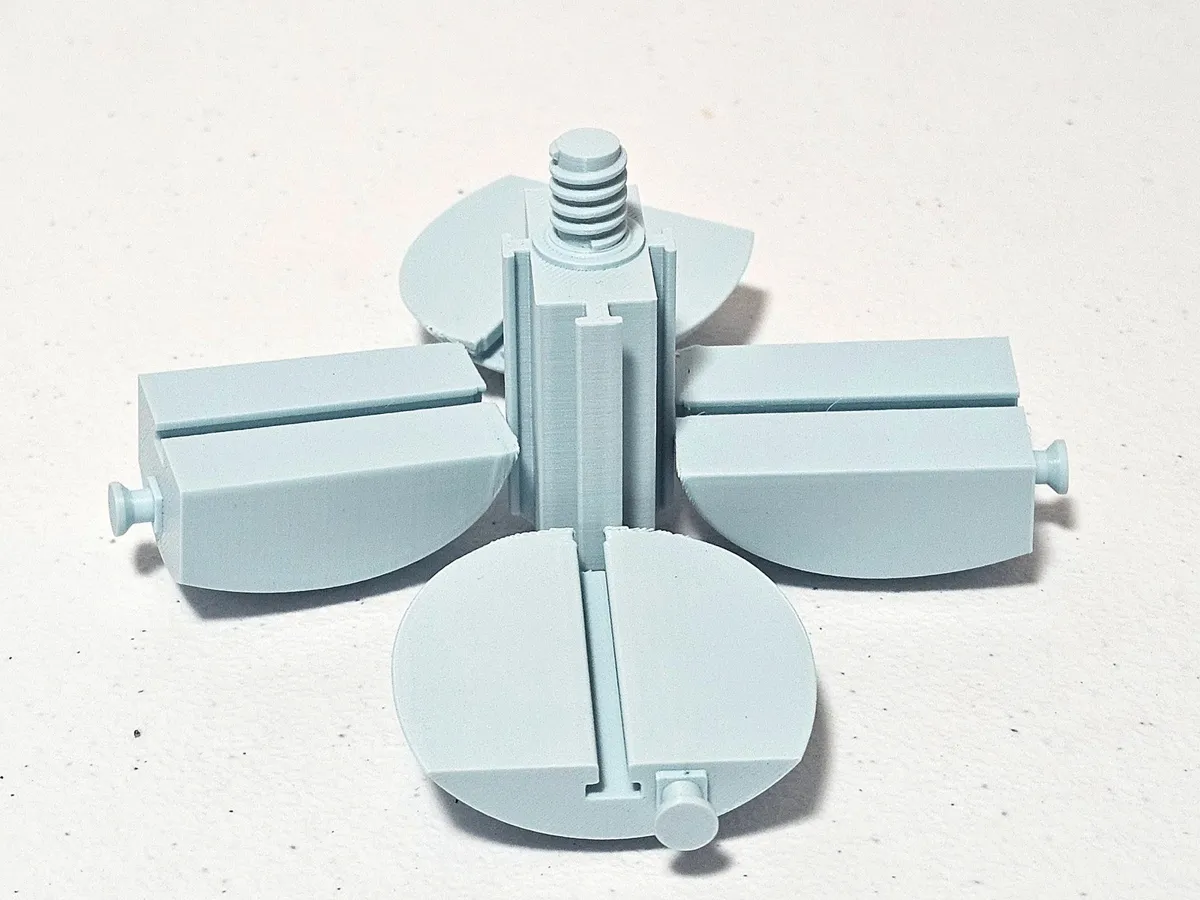
With the core out, the segments are free to fold in and come out through the rim of the cup.
Flat White 160: a single curve, nothing to trap the mold
160 mL to the brim, close to the flat white cups cited above. The study plans a 140 to 150 mL serving; from the profile, the surface sits about 4.8 to 2.4 mm below the rim. Whether that margin is enough to serve and carry the cup only use will tell: it has not been tested yet.
A single curve. From the flat base (Ø34 mm), a single quarter-ellipse arc rises to the rim (Ø72 mm). There is no inside corner to clean.
The rim is the widest point. No section below it is wider than the opening, so the profile has no undercut and allows a rigid, one-piece mold pulled straight out. Friction, adhesion and clay shrinkage can still grip the mold: actual release depends on the test with clay. The first version of the study had a 1 mm undercut (Ø70 rim and Ø72 body) and would have needed a collapsible mold; we opened the profile to remove that millimeter and simplify the mold.
Interior height of 49 mm. The rim is about 1.5 times wider than the depth: a low, open cup from the same family as the Cappuccino 200. A foot of about Ø42 mm and a 22 × 26 mm handle opening are included as finishing references.
The grip bar. The mold is a hollow dome with ribs inside and a bar across it, flush with the opening, used to hold, turn and pull the mold without pressing on the surface that forms the cup. In the study versions the bar was raised; in the printed version it sits flush, with room for fingers between the ribs.
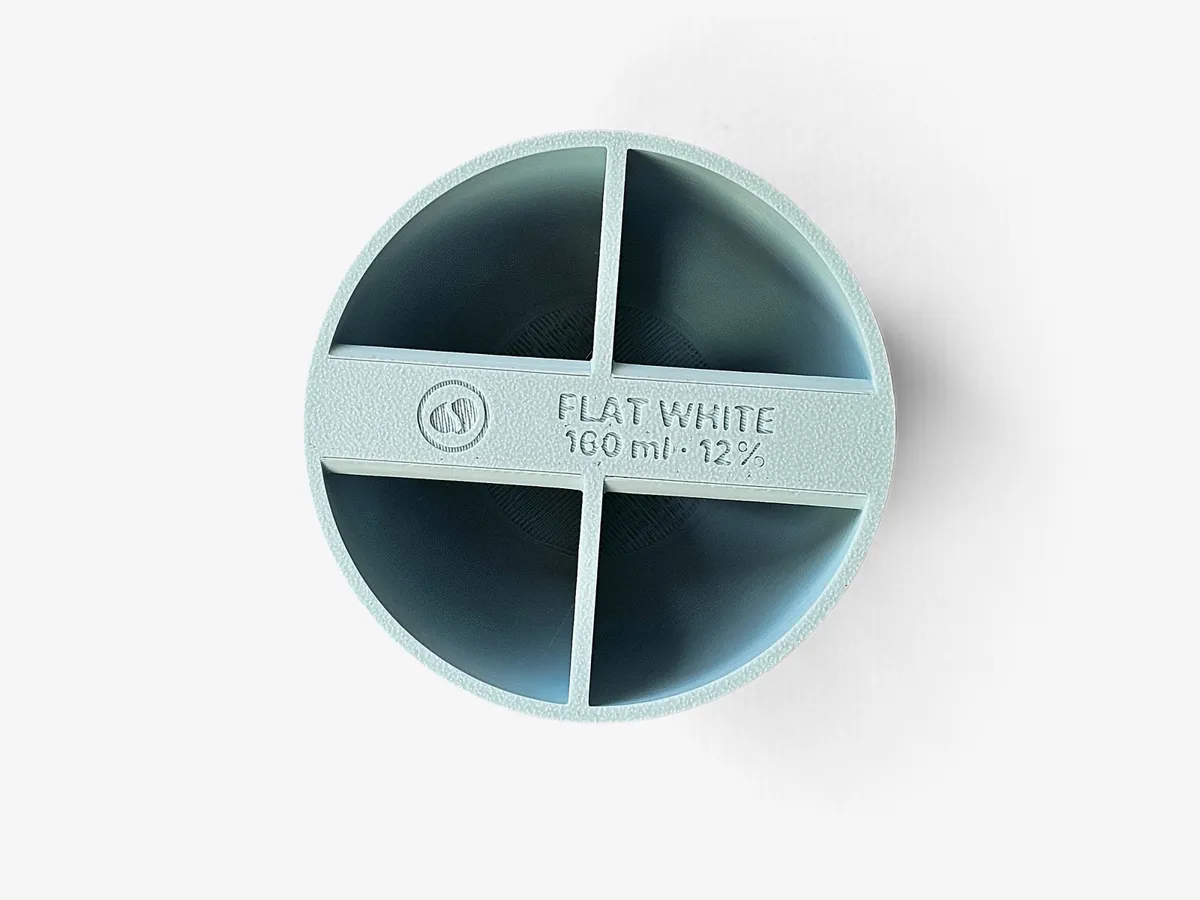
Inside the Flat White 160: ribs and grip bar. The engraving recalls the capacity and shrinkage the mold was calculated for.
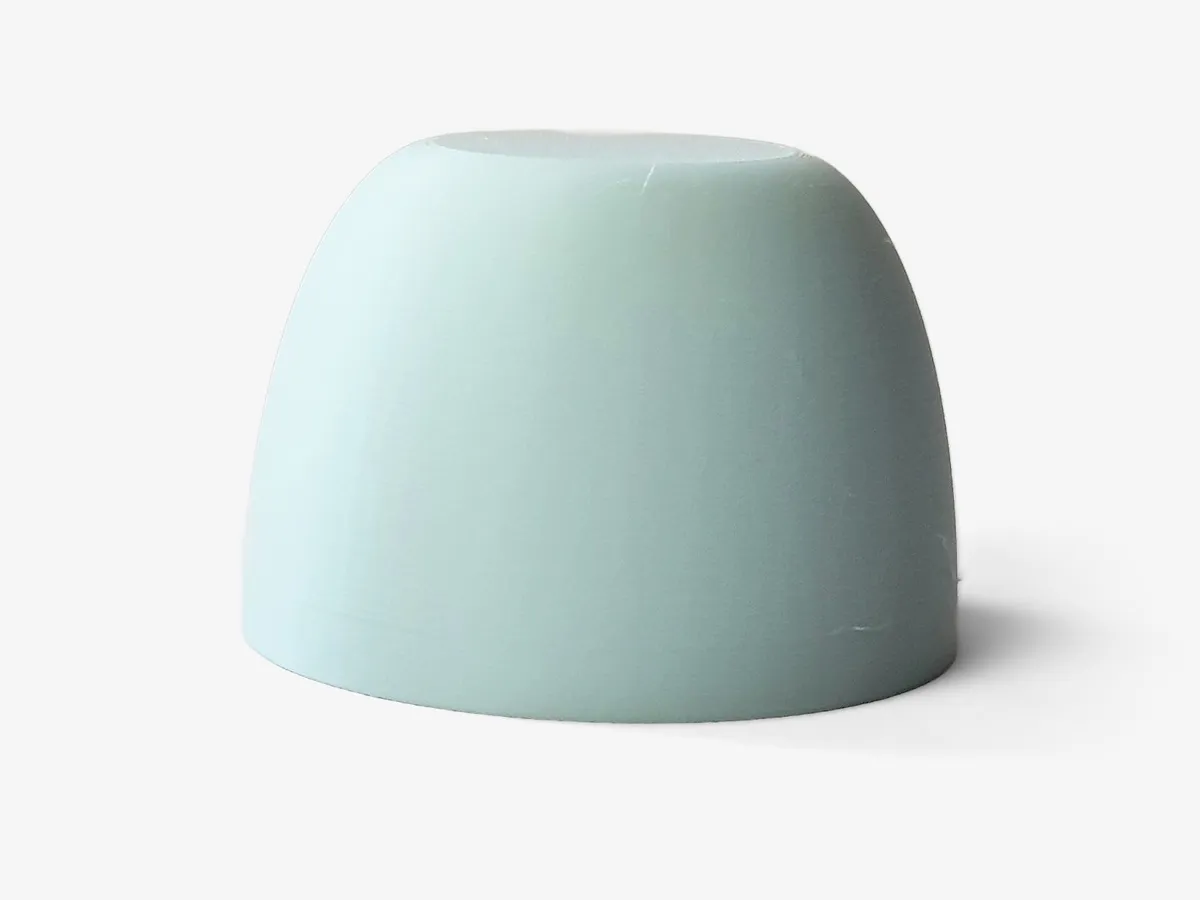
Turned over, the mold shows its smooth dome: this is where the clay slab is shaped.
Cappuccino 200: not a scaled-up Flat White
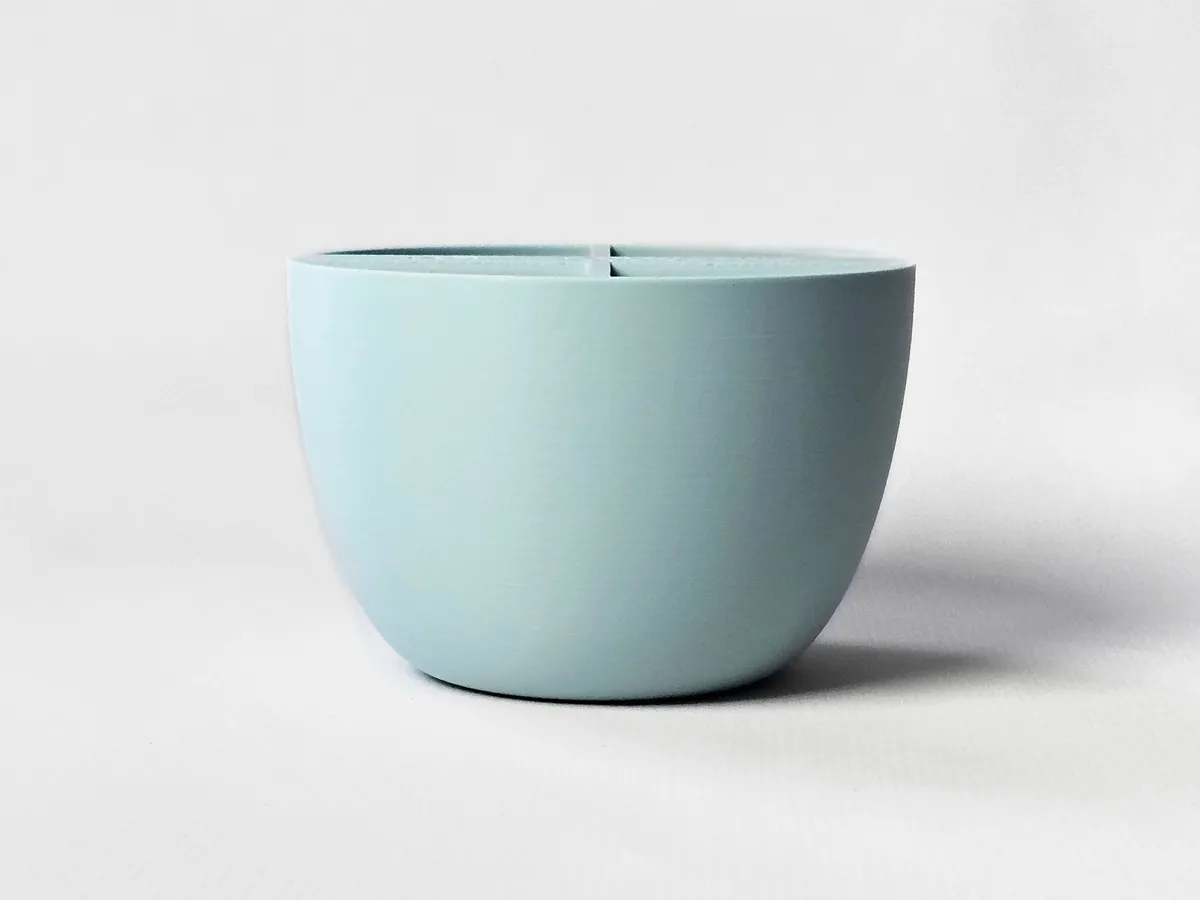
200 mL to the brim. The study plans 170 to 180 mL of drink, foam included; from the profile, the surface sits about 6.3 to 4.2 mm below the rim. That is the 150 to 180 mL range cited for cappuccino. This serving is a design figure and has not yet been checked in a fired cup.
The same family curve. A Ø38 mm flat base and a single quarter ellipse up to the Ø78 mm rim. No corner and no undercut: again a rigid, one-piece mold, with the same caveat about release with clay.
More rim, slightly more height. Simply scaling up the Flat White 160 would make the cup taller in the same proportion. Instead, from the 160 to the 200:
| Measurement | Flat White 160 | Cappuccino 200 | Change |
|---|---|---|---|
| Capacity to the brim | 160 mL | 200 mL | +25% |
| Interior rim | Ø72 mm | Ø78 mm | +8% |
| Interior height | 49 mm | 52 mm | +6% |
| Flat base | Ø34 mm | Ø38 mm | +12% |
| Rim area | 4,072 mm² | 4,778 mm² | +17% |
The opening area grows by 17%, and the cup stays low and open instead of becoming a tall mug. This is a design choice: it has not been tested with baristas, and we do not claim it makes better latte art. A foot of about Ø46 mm and a 24 × 30 mm handle opening are finishing references.
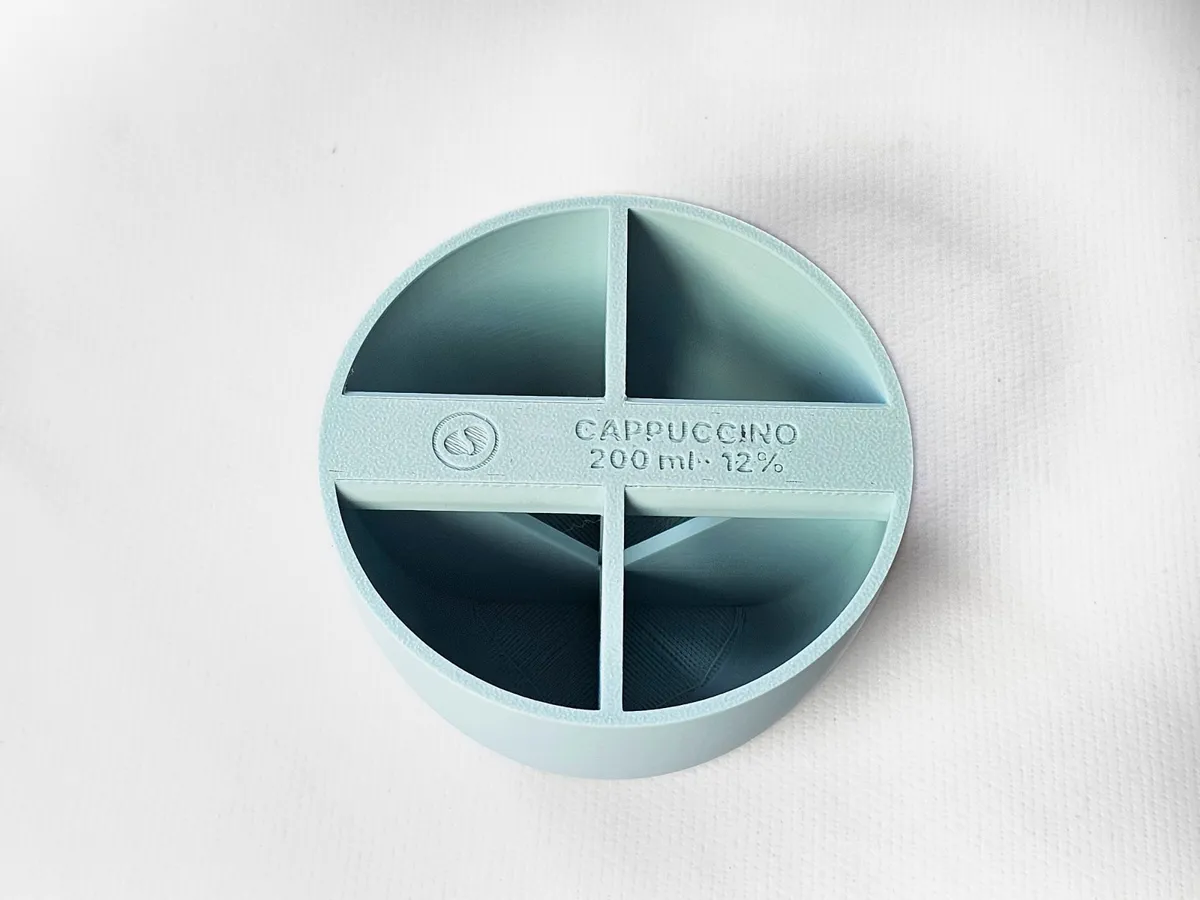
Is a 200 mL cup too big for a cappuccino?
It depends on the volume served. The 200 mL is the capacity to the brim; the planned serving is 170 to 180 mL, within the range cited for cappuccino. Anyone serving a traditional Italian cappuccino of about 150 mL (25 mL of espresso plus the milk, which goes from 100 to about 125 mL when steamed) leaves more free space in the Cappuccino 200. By nominal capacity, the Flat White 160 is closer to that volume, but with little margin to the brim.
Common to all three cups: wall, rim and shrinkage
Wall. The studies start from a wet (WET) slab of 5 mm in the wall and 5.5 mm in the base. With 12% shrinkage, that gives about 4.4 mm of wall and 4.8 mm of base after firing. The rim is thinned from the outside to about 3 mm.
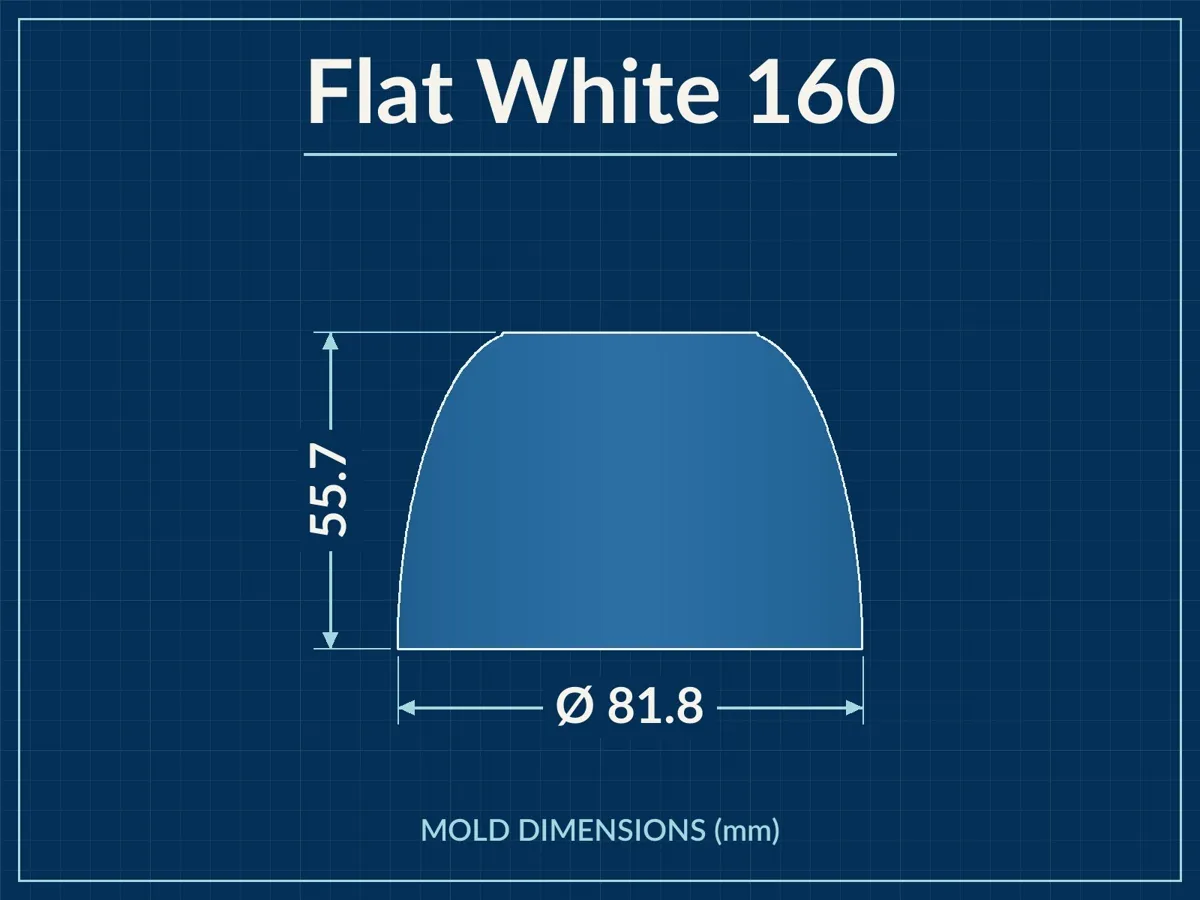
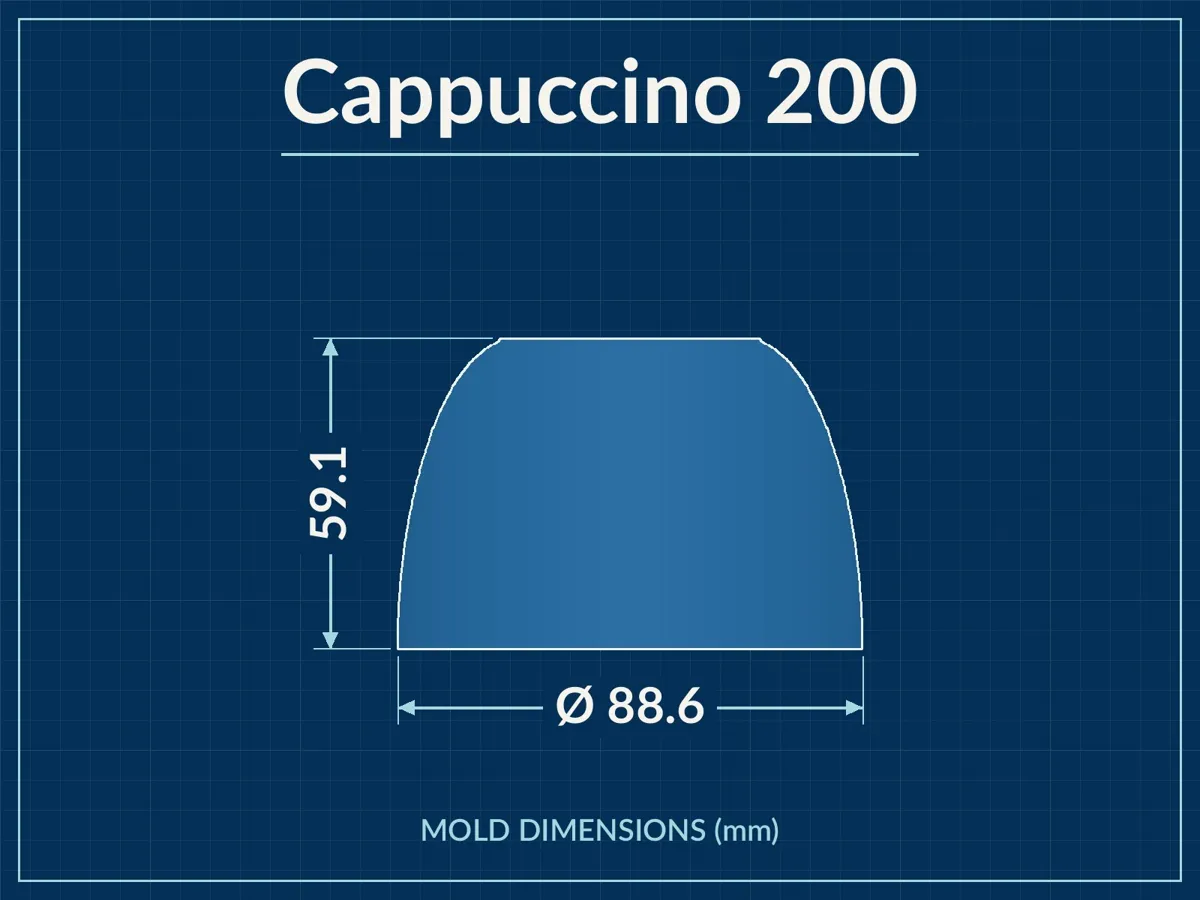
Shrinkage. Each linear dimension of the mold’s clay-forming surface is calculated by dividing the corresponding target fired dimension by 0.88, assuming 12% uniform linear shrinkage: this compensates for what the piece loses in drying and firing. Only that surface is enlarged; the bar, ribs and fittings keep their real print dimensions.
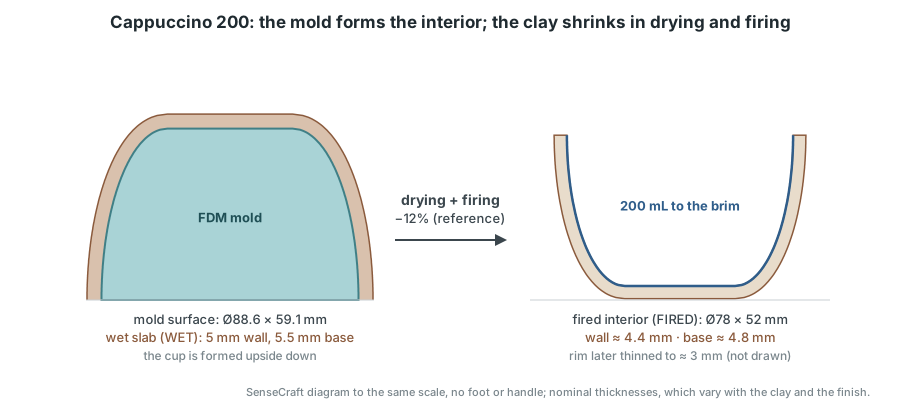
From mold to cup in the Cappuccino 200. SenseCraft teaching diagram to the same scale, with no foot or handle; thicknesses are nominal.
That is why each mold is larger than the finished cup:
| Cup (fired interior) | Mold surface (12%) |
|---|---|
| Espresso 80: Ø54 max. × 41 mm | Ø61.4 max. × 46.6 mm |
| Flat White 160: Ø72 × 49 mm | Ø81.8 × 55.7 mm |
| Cappuccino 200: Ø78 × 52 mm | Ø88.6 × 59.1 mm |
What if my clay shrinks more or less?
If your clay body shrinks by something other than 12%, the cup comes out with a different capacity. Using the same calculation as the studies, and assuming equal shrinkage in all directions:
| Actual shrinkage | Espresso 80 | Flat White 160 | Cappuccino 200 |
|---|---|---|---|
| 10% | ≈ 85 mL | ≈ 171 mL | ≈ 214 mL |
| 12% | ≈ 80 mL | ≈ 160 mL | ≈ 200 mL |
| 14% | ≈ 75 mL | ≈ 149 mL | ≈ 187 mL |
To estimate the total shrinkage of your clay body, mark and measure test bars while still wet, after drying and after firing, as in the SHAB test described by Digitalfire. Total shrinkage compares the wet measurement with the fired measurement, which is the basis of the design’s 12%. Height and diameter may shrink differently.
Why the print profile is what it is
For the rigid Flat White 160 and Cappuccino 200 molds:
- 0.12 mm layers, because the dome forms the interior of the cup and thinner layers leave smaller steps in the clay;
- 6 walls (perimeters), chosen to fill the mold’s nominal 2.4 mm shell with perimeters; the effective thickness depends on the extrusion width;
- opening down, no supports: in this position the shape only narrows as it rises, and the bar starts straight from the bed.
The Espresso 80 has separate parts and its own profile, described on the model page.
What we have not tested yet
The measurements were checked by calculation and in CAD, and all three molds have been printed. For the Flat White 160 and the Cappuccino 200, the test with clay and firing is still missing: mold release, actual capacity and finish. We have also not run latte art tests with baristas, tastings or temperature tests. Until then, the profiles are design choices, and that is how we describe them.
Where to download
The Espresso 80 Hold-All and the Cappuccino 200 are on MakerWorld, with files, print profile and guide. The Flat White 160 page is awaiting approval on MakerWorld; the link will be added here once it is released.

Cappuccino 200 cover on MakerWorld. The mold is a real photo; the cup and the scene are an illustrative image, rendered and retouched with AI.
Where this content comes from
The measurements and the reasons for each profile come from SenseCraft’s design studies for the three cups (September 2026), the CAD of the molds and photos of the printed molds. The drink definitions come from the sources cited below. The writing was assisted by AI tools and edited by SenseCraft. To see the molds in the context of hand-building techniques, read the guide to pottery without a wheel.
Sources cited
- Fabiana M. Carvalho and Charles Spence. The shape of the cup influences aroma, taste, and hedonic judgements of specialty coffee, Food Quality and Preference, vol. 68, pp. 315–321, 2018. DOI: 10.1016/j.foodqual.2018.04.003.
- Istituto Nazionale Espresso Italiano. Institutional presentation, with the parameters for certified Espresso Italiano and Cappuccino Italiano (PDF).
- Wikipedia. Cappuccino.
- Wikipedia. Flat white.
- Perfect Daily Grind. What Is a Flat White & How Is It Different From a Latte?, 2018.
- Daily Coffee News. Major Rule Changes Announced for 2016 World Barista Championship, 2015.
- Tony Hansen. SHAB: Shrinkage/Absorption Test, Digitalfire.
Limits
- The cup measurements are targets after firing (FIRED), calculated with a 12% reference linear shrinkage. Your clay and kiln may give a different result: measure the shrinkage of your clay body.
- Capacities are geometric, to the brim, without glaze or finishing. The amount actually served is smaller.
- The tulip shape of the Espresso 80 draws on a study with filter coffee. We have not yet run tasting or latte art tests with baristas, so we do not claim that any profile improves flavor, aroma or latte art.
- The Flat White 160 and Cappuccino 200 molds have been printed, but the test with clay and firing is not yet documented.
- The mold is a 3D-printed tool: it does not go in a ceramic kiln and it is not kitchenware. Food use depends on the clay body, the glaze and the firing, not on the mold.
Where to download
Files, print profile and manual are on MakerWorld.
Linked project
 Pottery
Espresso 80
A segmented forming mold for handbuilding small espresso cups in clay.
Basis: documentation — SenseCraft design studies for the three cups (Espresso Tulip 80 v0.1, Tulip 160 Flat White v0.3 and Tulip 200 Cappuccino v0.1, September 2026), CAD of the molds and real photos of the printed molds (October 2026); drink definitions from the sources cited at the end.