Application and audience
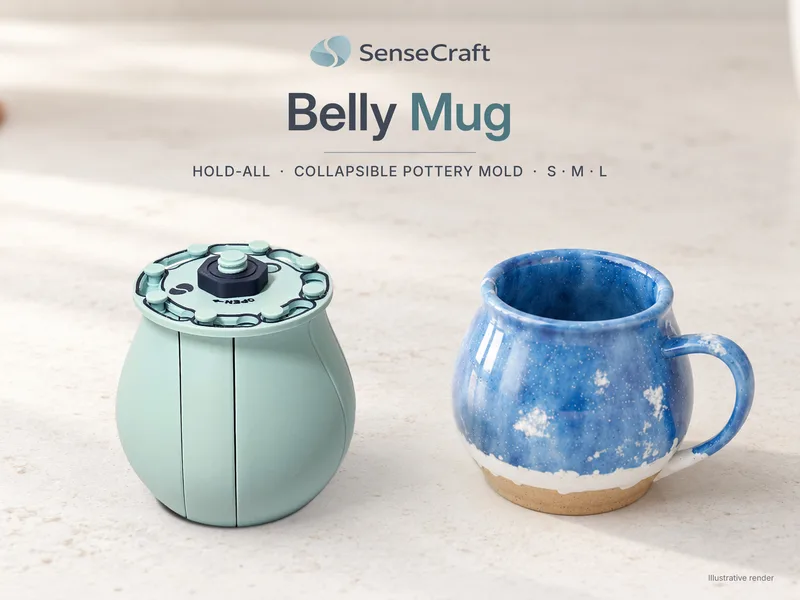
For slab-building potters making cups with a body wider than the rim.
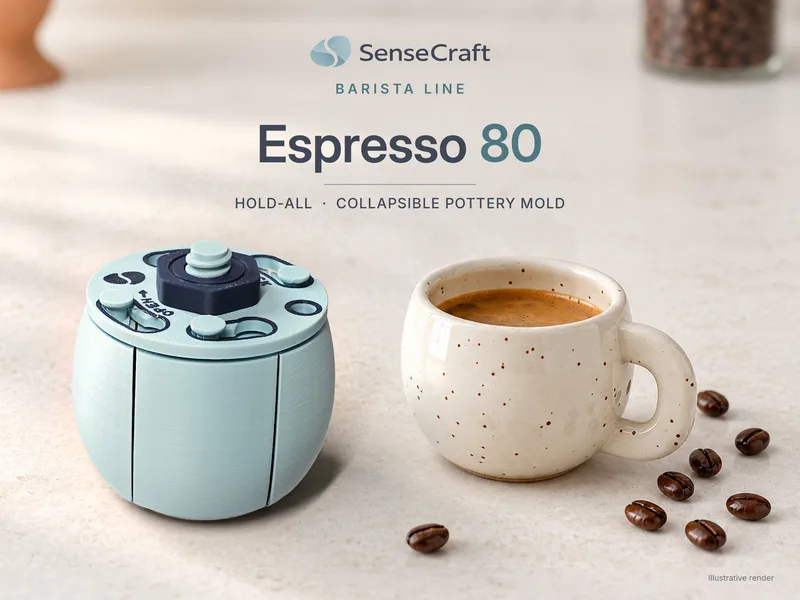
Espresso 80 Hold-All is the new version of the mold. The Lock Lid holds all four segments while you build the cup with the mold upside down; then the segments come out through the rim. The inner profile targets 80 mL after firing.
To compare mold types (plaster, MDF, 3D-printed, one-piece and collapsible), see pottery molds: types, how to choose and how to use.
Operation and assembly
- Stand the core on the table and slide the four segments onto it.
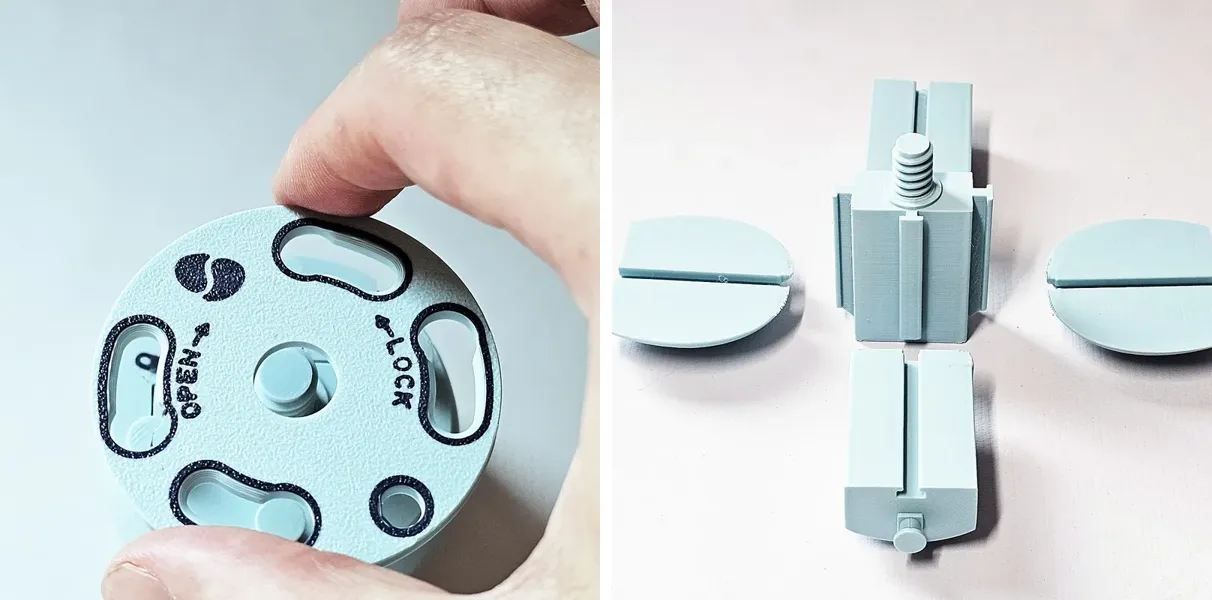
- Fit the Lock Lid and turn it to LOCK: the padlock shows in the window. Thread the hex nut by hand, no tools.
- Roll a 5 mm slab and cut the three body pieces with the paper templates in the guide: base, lower arc and upper arc.
- With the mold upside down, add the base, then the two arcs, scoring and slipping each joint.
- Flip mold and cup onto a board, remove the nut, turn the lid to OPEN and lift it off. Pull out the core.
- Collapse and remove the two small segments, then the two large ones, through the rim.
Demold when the cup holds its own shape but is still flexible. Do not let the clay shrink tight around the mold.
Dimensions and variants
- System
- core + 2 key segments + 2 side segments + Lock Lid + hex nut (7 parts)
- Nominal fired capacity
- 80 mL
- Target fired inner rim
- Ø48 mm
- Target fired maximum inner diameter
- Ø54 mm
- Target fired inner height
- 41 mm
- Target fired flat inner floor
- Ø24 mm
- Reference compensation
- 12% linear shrinkage
Printing information
- Profiles for Bambu Lab P1S, 0.4 mm nozzle, PLA: Single-Color (1 plate, about 2 h 36 min, 77 g) or Dual-Color with AMS (2 plates, about 2 h 54 min, 81 g).
- Keep the orientation of the files: the Lock Lid prints marked face down. Mechanism clearances are 0.3 mm.
- Do not scale the files: scaling also changes the clearances of the mechanism.
Care and use
Clay shrinkage and firing change the final capacity and dimensions. Use the 12% reference as a starting point and measure your own clay.
Manuals and instructions
User guide — Espresso 80 Hold-All
English · v1.5 · PDF with 1:1 paper templates (A4 or Letter)
Open “Files & Guides” on the project page to access the PDF.
Project questions
How does the mold come out of the cup?
The body of the cup is wider than its opening, so the mold comes apart from the inside: take off the nut, turn the lid to OPEN and lift it, pull the core, and the segments collapse inward: the two small ones first, then the two large ones, always through the rim. The full sequence and the logic behind it are in collapsible pottery molds: how they work and when to use one.
Does the file print the ceramic cup?
No. It prints the tool used to form clay. Drying and firing are part of the pottery process.
Can I change capacity by scaling the file?
Not recommended: scaling also changes the clearances of the lock and segments.
Is the original Espresso 80 still available?
Yes. The Pull-Lock version (8 segments and a central pin) stays on MakerWorld ↗.
Sources and documentation
Project documentation · reviewed .
Files and instructions on MakerWorld ↗