
What a mold does in slab building
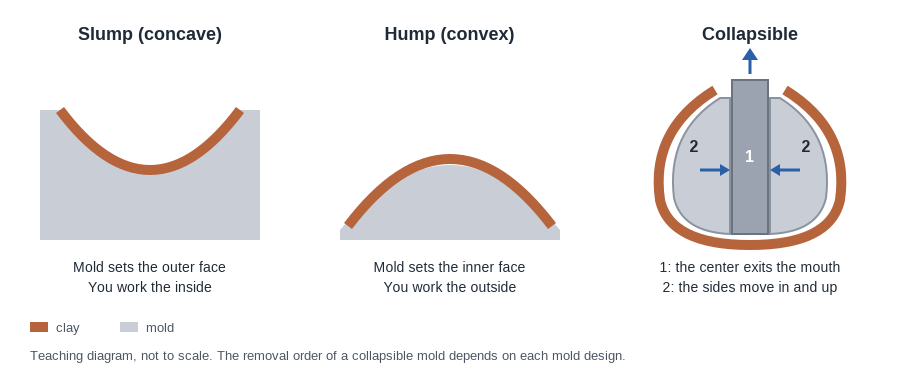
In slab building, you roll plastic clay into an even sheet and settle it onto the mold. The mold holds the shape while the clay firms up and controls one face of the piece: with a slump (concave) mold, the slab goes into a cavity and the mold controls the outer face; with a hump (convex) mold, the slab goes over a form and the mold controls the inner face. Before choosing, check how the piece will come out: a mold only works if the piece can go on, take the shape and come off without being pulled. Details in hump and slump molds for pottery.
Types of pottery molds
By material: plaster, MDF and 3D-printed
| Type | How it works | Good for | Watch out for |
|---|---|---|---|
| Plaster | It absorbs water. In slip casting, slip (liquid clay) is poured in and the plaster draws out the water; with plastic clay, it serves as a slab support or press mold. | Slip casting; slab support. | Plaster fragments in the clay cause pop-outs that show up after firing. Making your own mold takes a model, a box, mixing and drying. |
| MDF | A rigid form of engineered wood, for plastic-clay slabs (hump and slump). | Plates, platters and open shapes. | Each maker gives its own guidance on release agents and on drying the form: follow the one for your mold. |
| 3D-printed | Plastic (PLA), without the capillary absorption of plaster. Release depends on the separator recommended for the mold and on removing it at the right moment. | Repeatable slab shapes, including parts that come apart. | PLA softens with heat and does not go in the ceramic kiln. Check the piece’s exit path and your clay’s shrinkage. |
By how the piece comes out: hump, slump and collapsible
| Type | How the piece comes off | When you need it |
|---|---|---|
| Hump (convex) | The slab goes over a form; the piece is lifted off. | Open, low shapes where the widest point is the rim. |
| Slump (concave) | The slab goes into a cavity; the piece comes out through the opening. | Open shapes where the inside stays reachable for smoothing or decorating. |
| Collapsible | The mold comes apart inside the piece and the parts leave through the opening one by one. | When the body is wider than the opening, as in a tulip-shaped cup or a rounded mug: a one-piece mold would stay trapped. |
How to choose a mold: by the problem, not the name
Choosing by name leads to buying the wrong tool. The question that decides most is the state of the clay (plastic or slip) and then the shape of the piece. For the full comparison of plaster, MDF and 3D-printed molds, read plaster, MDF or 3D-printed pottery mold: how to choose.
| If your process is… | Mold to use | Does a SenseCraft mold fit? |
|---|---|---|
| Slip casting | Plaster mold | No. Our molds lack the absorption of plaster. |
| Plastic-clay slab with a body wider than the opening (tulip cup, rounded mug) | Collapsible mold | Yes: Espresso 80, Belly Mug, Orb Mug and Yunomi were designed for this. |
| Plastic-clay slab for an open, low cup (the widest point is the rim) | Rigid one-piece (hump) mold | Yes, for two cups: Flat White 160 and Cappuccino 200. |
| Plates, platters and other shallow forms | A simple support mold, in any material | No. We do not make plate or platter molds. |
| Cutting slabs to the same outline every time | Cutting template | Sometimes: there are printed templates in the mold tool sets, but cardboard works too. |
| A free-form piece made by hand | Hand building, no mold | Usually you do not need a mold. |
Four questions before you choose
- Is the clay plastic or slip? Slip calls for plaster.
- Is the opening narrower than the body? If so, the mold has to come apart.
- What is your clay body’s shrinkage? The mold measurements change with it.
- Did you read the project manual before printing?
Mold size and shrinkage
Clay shrinks as it dries and fires, so the mold is larger than the finished piece. The math is simple: each mold-surface measurement is the corresponding fired (FIRED) measurement divided by (1 − shrinkage); between an inner and an outer measurement, the wall thickness comes in. With the 12% linear shrinkage reference, you divide by 0.88. The mold surface is what the wet clay (WET) touches; the bar, ribs and fits keep the real print measurements.
| Mold | Fired piece (inside) | Mold surface, at 12% |
|---|---|---|
| Espresso 80 | Rim Ø48 mm; maximum Ø54 mm; height 41 mm | Rim Ø54.55 mm; maximum Ø61.36 mm; height 46.59 mm |
| Flat White 160 | Ø72 mm × 49 mm | Ø81.8 mm × 55.7 mm |
| Cappuccino 200 | Ø78 mm × 52 mm | Ø88.6 mm × 59.1 mm |
These numbers are targets after firing, calculated for 12% shrinkage. Your clay and your kiln may give another result: measure your own clay’s shrinkage with test bars, as in clay shrinkage: how to calculate it.
How to use a mold with a clay slab, in five steps
- Prepare the mold and the contact surface. A clean, sound mold; use the separator recommended for it and test on a sample of the same clay. No layer fixes a geometry problem.
- Roll an even slab, with extra beyond the outline (see how to roll out a clay slab). The SenseCraft mold guides call for a 5 mm slab on the Espresso 80 and 6 mm on the Belly Mug.
- Settle the slab on the mold and close the seams. On the Hold-All molds, the mold sits upside down and the slab goes on the outside of it; every seam is scored and gets slip (how to join clay).
- Release at the right moment. When the piece holds itself up but is still flexible; do not let the clay shrink onto the mold. There is no fixed time, because it depends on the clay, the thickness, the humidity and the temperature (leather-hard clay).
- Take the mold out and dry the piece on a support. On collapsible molds the parts leave through the opening in the order given in the guide; on one-piece molds the mold comes out straight. Follow how to dry pottery without cracking.
SenseCraft molds
SenseCraft designs 3D-printed molds and tools for slab building. The files, print profiles and user guides are on MakerWorld, free. The images on the cards are the MakerWorld covers, AI-generated illustrations; real photos of the molds are on the Espresso 80 and Belly Mug pages.
 Mold
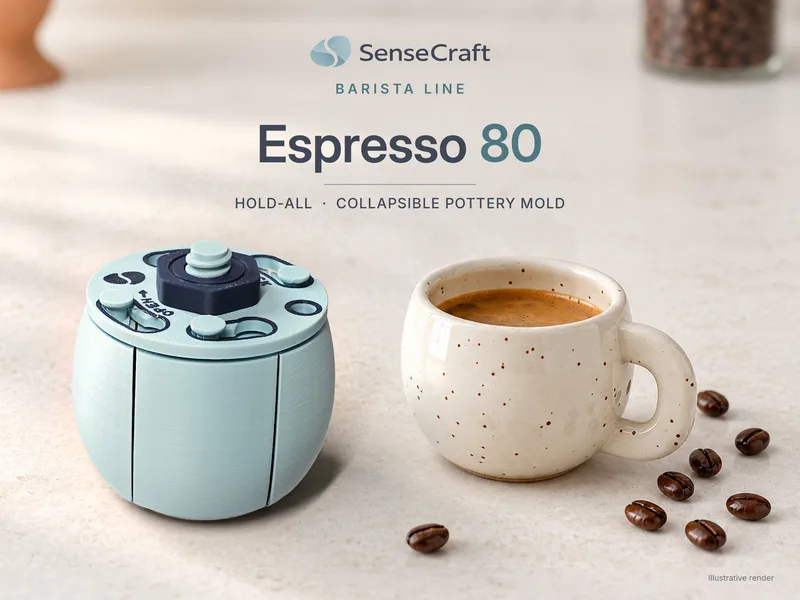
Espresso 80
Hold-All collapsible mold for an espresso cup: 80 mL nominal capacity after firing, a Ø48 mm inner rim, a 7-part system and a 12% linear shrinkage reference.
 Mold
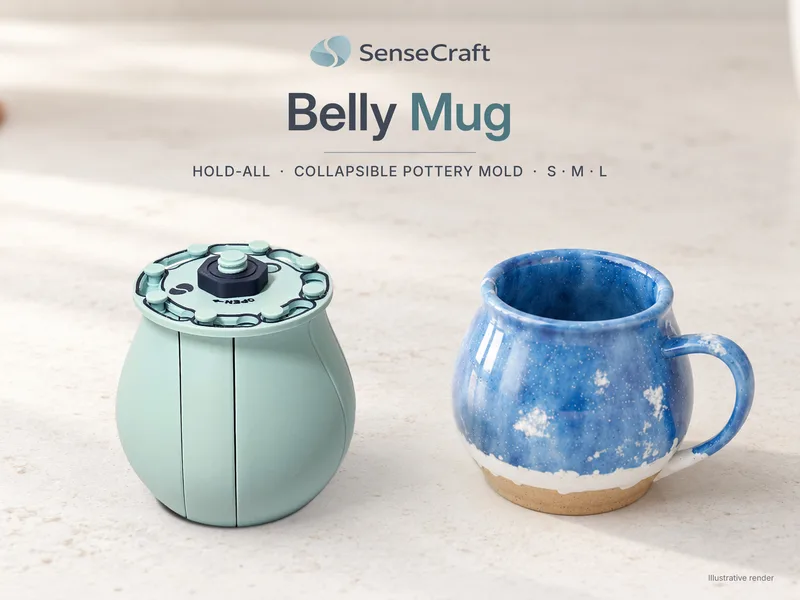
Belly Mug
Hold-All collapsible mold for a rounded mug, in three coordinated sizes: S (≈123 mL), M (≈248 mL) and L (≈427 mL), capacities to the brim, with reference dimensions after firing and 12% shrinkage.
 Mold
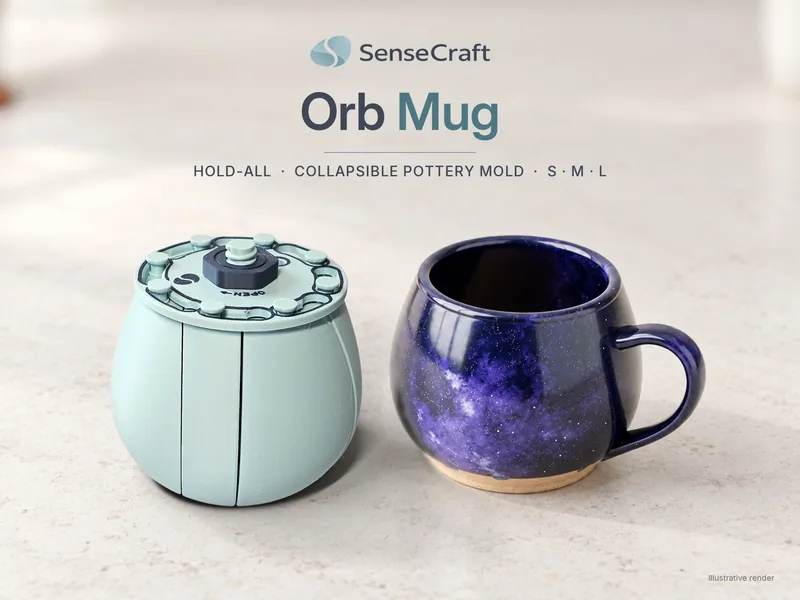
Orb Mug
Hold-All collapsible slab mold for round mugs, in three sizes (S, M and L).
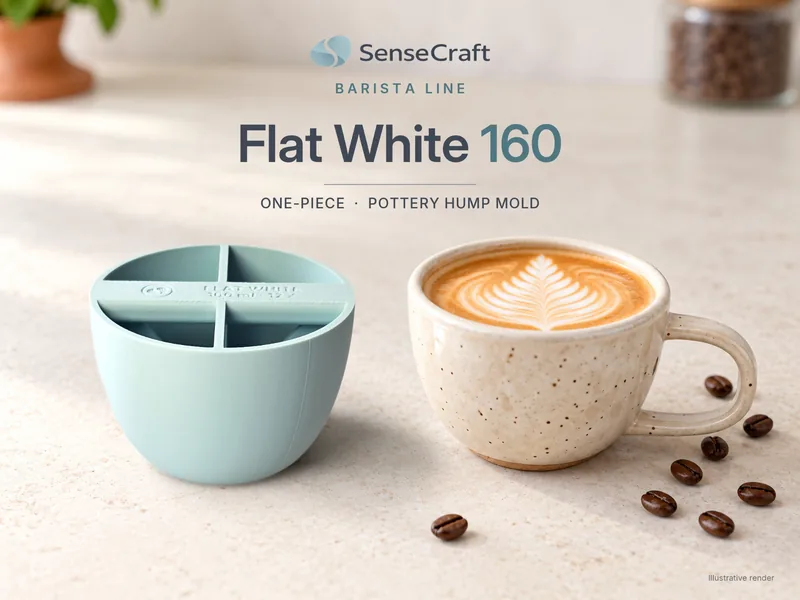 Mold
Flat White 160 · Barista Line
Rigid one-piece hump mold for a 160 mL flat white cup (to the brim), Ø72 mm inner opening. The profile has no undercut.
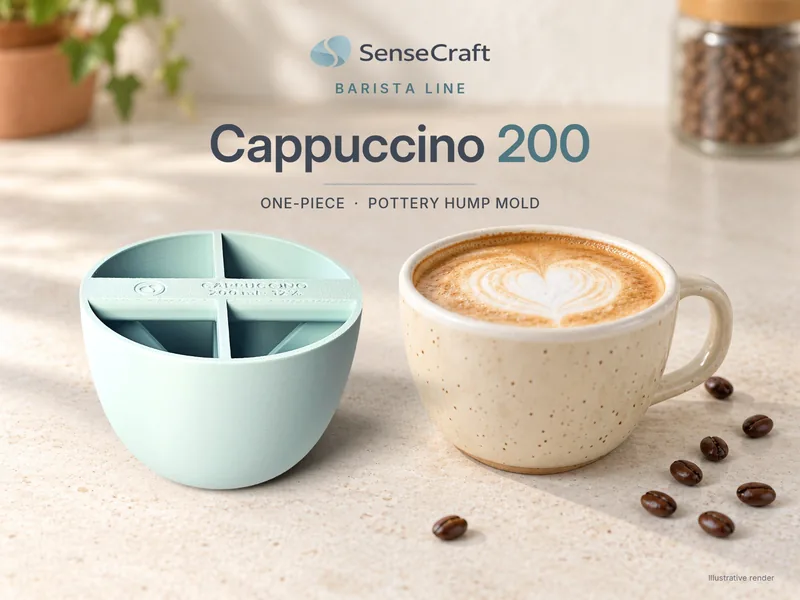 Mold
Cappuccino 200 · Barista Line
Rigid one-piece hump mold for a 200 mL cappuccino cup (to the brim), Ø78 mm inner opening. The profile has no undercut.
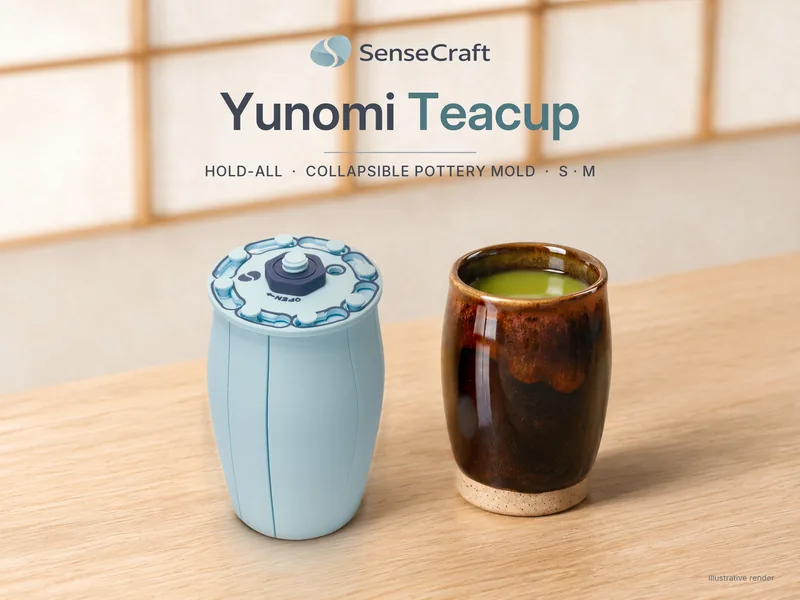 Mold
Yunomi Teacup
Hold-All collapsible mold for Japanese-style teacups, in two sizes (S and M).
Supporting tools
The Espresso 80, Belly Mug, Orb Mug, Flat White 160 and Cappuccino 200 molds have sets of experimental tools (cutters, templates, handle formers and rim gauges) that are still being tested: see the free models section in all projects. Two tools of more general use:
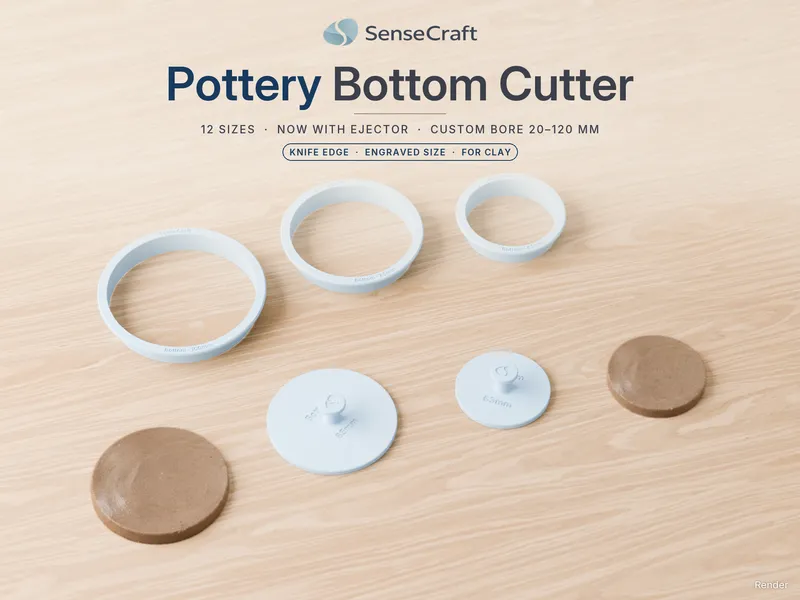 Tool
Parametric Bottom Cutter
A round cutter for clay discs (mug and cup bottoms) in 12 ready sizes from 30 to 115 mm, with an online customizer for wet-clay cutting diameters from 20 to 120 mm.
 Tool
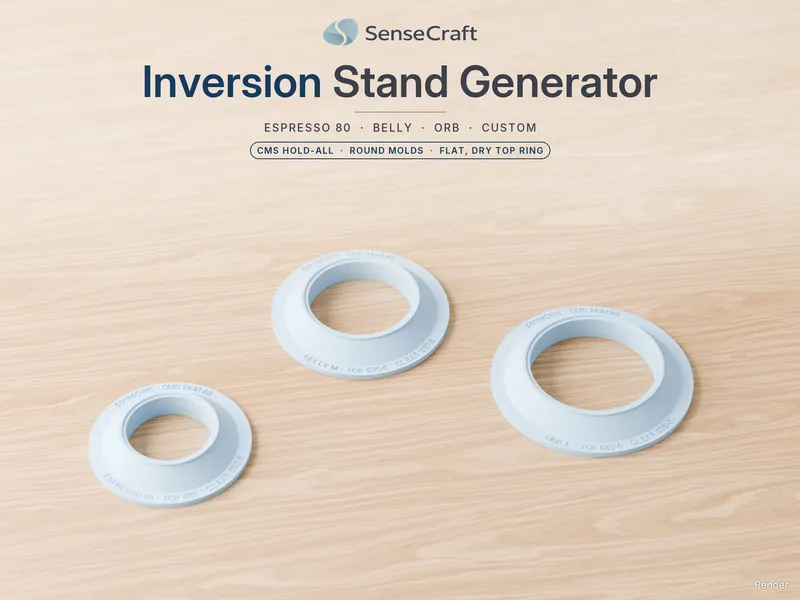
Slab Mold Inversion Stand (generator)
A parametric stand that holds a slab mold upside down while you attach the clay bottom. Presets for the Espresso 80, Belly and Orb molds.
What SenseCraft does not do
- Plaster molds and slip casting: our molds lack the absorption of plaster.
- Molds for plates, platters or other shallow forms.
- The potter’s wheel and wheel tools.
- Ceramic pieces: SenseCraft designs 3D-printed tools; the ceramics are made by whoever uses the mold.
Where to get one and where to download the file
Plaster and MDF molds are sold by ceramic supply shops and by makers of forms for potters; compare the shape and measurements with the piece you want to make. SenseCraft molds have a free file on MakerWorld. The Espresso 80 and Belly Mug pages give measurements, how they work and print information.
Frequently asked questions about pottery molds
Where can I find molds for pottery?
At ceramic supply and mold shops, from makers of plaster and MDF forms, and as files to print in 3D. SenseCraft designs 3D-printed molds for cups and mugs made from clay slabs: files and print profiles are free on MakerWorld.
What material are pottery molds made of?
Plaster, MDF or wood, unglazed ceramic and 3D-printed plastic are among the most common, and each one handles contact, moisture and stiffness differently. Plaster absorbs water; printed plastic does not. See the comparison of plaster, MDF and 3D-printed molds.
What are the types of pottery molds?
By material: plaster, MDF and 3D-printed. By how the piece comes out: hump (convex, the slab goes over a form), slump (concave, the slab goes into a cavity) and collapsible (it comes apart inside the piece so it can leave through an opening narrower than the body). The tables above bring the types together.
What is the difference between a hump mold and a slump mold?
With a slump (concave) mold, the mold controls the outer face and you work the inside. With a hump (convex) mold, the mold controls the inner face and you work the outside, where you can also plan a foot. See how to shape the slab and release it.
How do I make a pottery mold?
It depends on the type. A plaster mold needs a model, a box, mixing, pouring and drying: see how to plan, pour and dry a plaster mold. A 3D-printed mold starts from a ready file, like the SenseCraft molds, which include a profile for the Bambu Lab P1S, a 0.4 mm nozzle and PLA.
Does a 3D-printed mold replace a plaster mold?
Not in every case. A plaster mold absorbs water and is the one used for slip casting; a printed mold lacks the capillary absorption of plaster and was designed for plastic clay in slabs. SenseCraft molds are not for slip casting.
Why is the mold larger than the finished piece?
Because clay shrinks as it dries and fires. Each mold-surface measurement is the corresponding fired measurement divided by (1 − shrinkage). With a 12% shrinkage reference, a fired opening of Ø48 mm calls for Ø54.55 mm on the mold surface. Measure the shrinkage of your own clay: how to calculate clay shrinkage.
Can I change a mold’s size by scaling the file?
We do not recommend it: scaling also changes the clearances of the latch, the fits and the segments. Each size of the SenseCraft molds has its own set of parts and clearances.
Does a printed mold go in the kiln, or is it food safe?
No. The mold is a plastic tool (PLA): it does not go in the ceramic kiln, the microwave or the dishwasher, and it is not a kitchen utensil. Only the clay goes in the kiln. Whether the finished piece is suitable for food depends on the clay, the glaze and the firing, not on the mold.
Read next
- Collapsible pottery molds: how they work and when to use one
- Plaster, MDF or 3D-printed pottery mold: how to choose
- Espresso cup mold for pottery: how the Espresso 80 comes apart
- How to keep clay from sticking to a pottery mold
- How to make a belly mug with a collapsible pottery mold
- How to size a pottery mold: from cup volume to wet clay size
- Pottery stuck in the mold, cracked seams and warped rims
- 3D-printed pottery molds: how to print, clean and store them
- Hump and slump molds for pottery: how to shape the slab and release it
- How to make a plaster mold for pottery
- Clay shrinkage: how to calculate it
- Pottery without a wheel: handbuilding techniques
Limits
- This guide combines the SenseCraft project pages and user guides with the literature review in the book Ceramics by Hand (chapters 16, 17 and 19). It is not the result of comparative tests between mold types: no type is best in every case.
- Measurements are targets after firing, calculated with a 12% linear shrinkage reference. Your clay and your kiln may give another result.
- SenseCraft molds are 3D-printed tools in PLA: they do not go in the ceramic kiln, they are not kitchen utensils and they are not for food contact. Using the finished piece with food depends on the clay, the glaze and the firing.
- We do not name makers or shops of other molds; always check the guidance from the maker of the mold you use.