
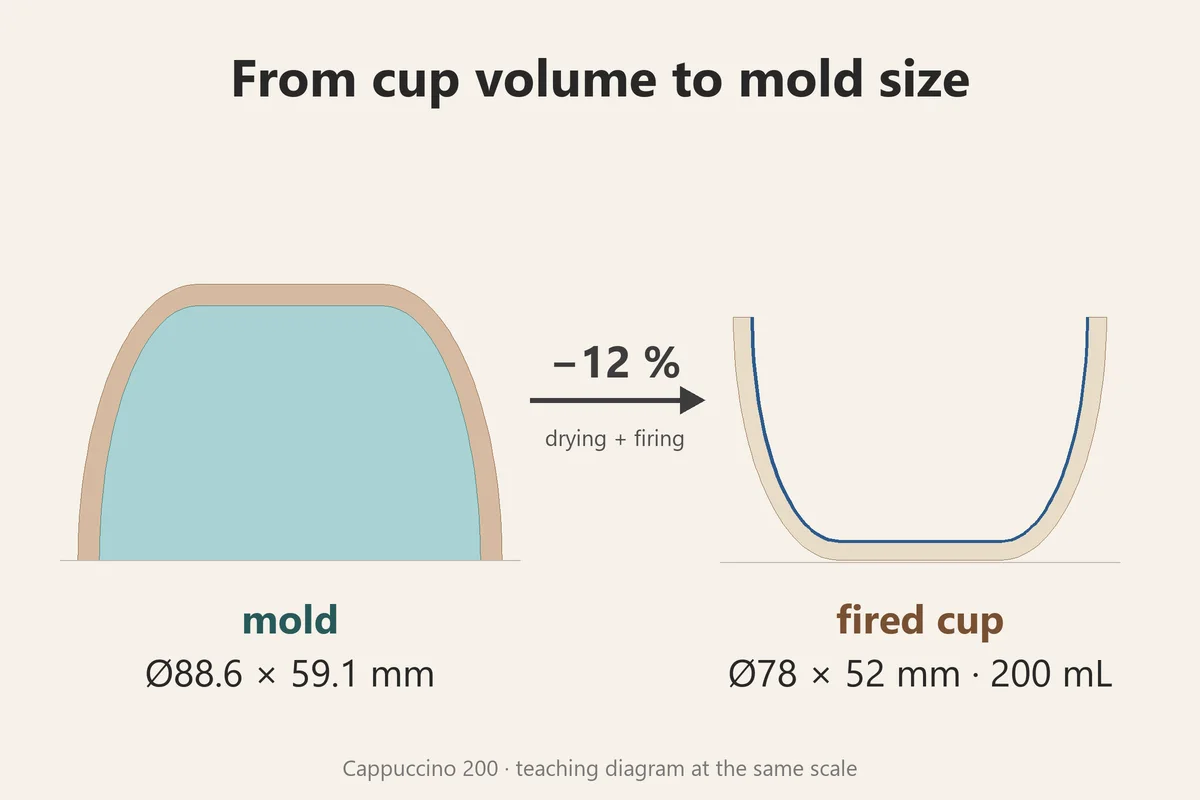
To choose the size of a pottery mold, start from the finished piece: the capacity and the opening you want after firing. Each linear dimension of the mold’s clay-forming surface is the corresponding fired dimension divided by (1 − shrinkage); at a 12 % reference linear shrinkage you divide by 0.88, so the mold is about 13.6 % larger in every dimension. Capacity changes more than length: with the same factor, the fired internal capacity is about 68 % of the wet piece’s internal volume.
This article takes the math from the clay shrinkage article to a practical decision: which mold to pick for the cup or mug you want. The examples use the published sizes of SenseCraft molds. The overview of the techniques is in the guide to pottery without a wheel.
Which mug dimensions should you decide first?
The question “which mold do I use?” depends on three numbers of the finished piece: capacity, inside rim diameter and inside height. All of them are inside sizes, after firing (FIRED). The mold follows from them.
In the projects below, the nominal capacity is the inside volume calculated to the rim, as a fired target; it is not a measurement of a fired piece. This convention lets you compare one piece with another. Capacity to the rim is not necessarily the volume served: the headroom depends on the drink and on how it is served.
| Mold | Capacity to the rim | Inside rim diameter | Widest diameter (inside) | Inside height |
|---|---|---|---|---|
| Espresso 80 | 80 mL | Ø48 mm | Ø54 mm | 41 mm |
| Flat White 160 | 160 mL | Ø72 mm | Ø72 mm (the rim) | 49 mm |
| Cappuccino 200 | 200 mL | Ø78 mm | Ø78 mm (the rim) | 52 mm |
| Belly Mug S | ≈123 mL | Ø46 mm | Ø62 mm | 53 mm |
| Belly Mug M | ≈248 mL | Ø58 mm | Ø77 mm | 69 mm |
| Belly Mug L | ≈427 mL | Ø68 mm | Ø90 mm | 84 mm |
Fired (FIRED) targets at a 12 % reference linear shrinkage, from the Espresso 80 and Belly Mug pages and the Barista Line article.
How much drink fits in the cup?
It depends on the drink. In the Barista Line studies, the planned serving is 30 to 50 mL in the Espresso 80, 140 to 150 mL in the Flat White 160 and 170 to 180 mL in the Cappuccino 200. As an outside reference, the Istituto Nazionale Espresso Italiano describes the espresso cup as holding 50 to 100 mL and the cup for its certified Italian cappuccino as holding 150 to 160 mL, served full to the brim, with the foam on top. So some drinks are meant to fill the cup and others are served with room to spare. Choose by the volume you serve and the headroom you want below the rim.
Narrow rim or wide rim?
The rim changes how you drink, how you clean and how the mold comes out. When the widest diameter sits below the rim, as in the Espresso 80 and the Belly Mug, there is an undercut: a rigid one-piece core cannot be pulled straight out. In a reusable rigid mold, the usual answer is to split it into segments that collapse inward, as these two do (flexible or sacrificial cores also exist); when the rim is the widest point, as in the Flat White 160 and the Cappuccino 200, a rigid one-piece mold can come out straight. The reasoning is in collapsible pottery molds.
From fired size to wet clay size
Wet clay size here means the size of the clay in its wet (WET) state, when it is formed over the mold; not at leather-hard and not bone-dry. Our mold designs use a reference total linear clay shrinkage of 12 %, from the wet state to the fired state. It already includes drying and firing; do not apply it again.
The calculation is a division:
mold size = fired size ÷ (1 − shrinkage)
At 12 %, the divisor is 0.88. Only the surface that shapes the clay is enlarged; joints, locks and grips on the mold keep their real print sizes.
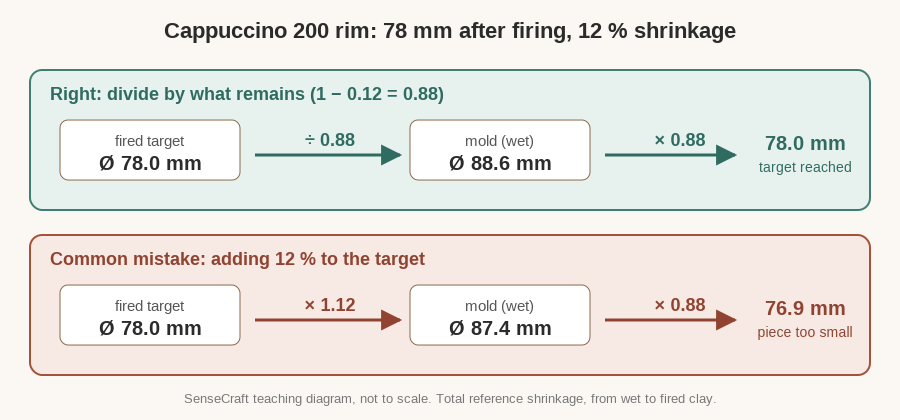
SenseCraft teaching diagram based on chapter 4 of Ceramics by Hand, not to scale.
Why divide instead of adding 12 %?
Because shrinkage is a fraction of the wet size, not of the fired size. On the Cappuccino 200, the fired inside rim diameter is Ø78 mm. Dividing, the mold is Ø88.6 mm, and 88.6 × 0.88 gives back 78. Adding 12 %, the mold would be Ø87.4 mm, and the cup would come out at 87.4 × 0.88 ≈ 76.9 mm: more than 1 mm short at the rim. In capacity the error grows, because all three dimensions enter the calculation: each comes out about 1.4 % smaller (1.12 × 0.88 = 0.9856), and the volume about 4 % smaller (0.9856³ ≈ 0.957). The volume relationship is explained below, in the section on the cube of the factor.
| Piece (fired inside) | Mold surface (÷ 0.88) |
|---|---|
| Espresso 80: Ø48 rim · Ø54 max. × 41 mm | Ø54.5 · Ø61.4 × 46.6 mm |
| Flat White 160: Ø72 × 49 mm | Ø81.8 × 55.7 mm |
| Cappuccino 200: Ø78 × 52 mm | Ø88.6 × 59.1 mm |
| Belly Mug S: Ø46 rim · Ø62 max. × 53 mm | Ø52.3 · Ø70.5 × 60.2 mm |
| Belly Mug M: Ø58 rim · Ø77 max. × 69 mm | Ø65.9 · Ø87.5 × 78.4 mm |
| Belly Mug L: Ø68 rim · Ø90 max. × 84 mm | Ø77.3 · Ø102.3 × 95.5 mm |
Values calculated with the formula (size ÷ 0.88), rounded to 0.1 mm. For the Flat White 160 and the Cappuccino 200 they match the dimensions measured on the print file; in the other rows they are the result of the calculation, for comparison.
Does slab thickness change the size of the piece?
In these molds the clay covers the mold from the outside and the mold forms the inside. In the ideal geometry, slab thickness changes the outside size, the weight and the drying behavior, but not the calculated capacity. On a real piece, seams, inside finishing and uneven shrinkage can change the final capacity. Thickness matters for another reason too: the paper templates in each guide were drawn for one thickness (5 mm for the Espresso 80, 6 mm for the Belly Mug). With a different slab thickness, the cut pieces may no longer fit together as designed.
Capacity changes with the cube of the factor
Length shrinks once; area, twice; volume, three times. With equal shrinkage in every direction, fired capacity is wet capacity multiplied by 0.88³ ≈ 0.68. That is why the cavity formed by the wet clay has a much larger volume than the finished cup:
| Piece | Fired, to the rim | Estimated inside volume of the wet piece, to the rim (÷ 0.68) |
|---|---|---|
| Espresso 80 | 80 mL | ≈117 mL |
| Flat White 160 | 160 mL | ≈235 mL |
| Cappuccino 200 | 200 mL | ≈293 mL |
| Belly Mug S | ≈123 mL | ≈180 mL |
| Belly Mug M | ≈248 mL | ≈364 mL |
| Belly Mug L | ≈427 mL | ≈627 mL |
Calculated values, assuming a uniform 12 % shrinkage in all three directions.
If you estimate the volume on the wet piece and expect the same number after firing, you will be off by about a third. The reverse calculation is the way to check: the wet volume times 0.68 should give back the fired capacity.
What mold size do you need for a 300 mL mug?
By the math, 300 mL fired calls for about 300 ÷ 0.68 ≈ 440 mL of inside volume in the wet clay, at 12 % shrinkage equal in every direction. But volume alone does not define the mold: the same capacity fits a tall, narrow mug or a short, wide one. Also decide the fired rim and height and divide each by 0.88. None of the molds in the table holds 300 mL to the rim; the Belly Mug M (≈248 mL) and L (≈427 mL) sit one below and one above.
What if my clay shrinks more or less than 12 %?
The piece comes out with a different capacity, and the mold stays the same. The volume factor becomes [(1 − r) ÷ 0.88]³, where r is the total shrinkage of your clay body:
| Mold | 10 % | 12 % (reference) | 14 % |
|---|---|---|---|
| Espresso 80 | ≈85 mL | 80 mL | ≈75 mL |
| Flat White 160 | ≈170 mL | 160 mL | ≈150 mL |
| Cappuccino 200 | ≈215 mL | 200 mL | ≈185 mL |
| Belly Mug S | ≈130 mL | ≈123 mL | ≈115 mL |
| Belly Mug M | ≈265 mL | ≈248 mL | ≈230 mL |
| Belly Mug L | ≈455 mL | ≈427 mL | ≈400 mL |
The 10 % and 14 % estimates are rounded to the nearest 5 mL; the 12 % column keeps the nominal design capacities. Equal shrinkage in every direction is assumed; these are not forecasts for any clay body.
A two-point difference in shrinkage changes capacity by about 7 %. Before choosing by the last milliliter, measure your clay’s shrinkage with wet, dry and fired test bars, as in the SHAB test described by Digitalfire; the step-by-step routine is in the shrinkage article. Note the direction too: shrinkage can differ in height and in diameter.
Can I print the mold at a larger scale to get more volume?
It is not recommended for collapsible molds or for any mold with interlocking parts. Scaling the file up or down also changes the clearances of the lock and segments, and the mechanism may no longer work as designed; that is why each Belly Mug size is its own set, with its own clearances, not the same file enlarged. Changing the scale would mean redesigning and testing the joints. The math is also steep: 10 % more in every dimension gives 1.1³ ≈ 1.33, about 33 % more volume. If the size does not suit you, choose another mold.
How to choose: a six-step routine
- Set the volume you serve and, when it makes sense for the drink, add headroom below the rim; capacity to the rim is the number to compare.
- Choose the opening diameter for the use: espresso, a milk drink or a wide mug.
- Check whether the widest diameter sits below the rim. If it does, a rigid one-piece mold will not come out: use a collapsible mold.
- Adjust for your shrinkage. If your clay shrinks more than 12 %, the piece comes out smaller; use the table above to see how much.
- Use the slab thickness in the mold’s guide, because the paper templates were drawn for it.
- Measure your first finished piece, fired and finished. On a watertight piece, fill it with water to the rim and weigh the water: 1 g is about 1 mL. On a porous, unglazed piece, absorption skews the reading. Glaze also changes the capacity slightly. Write the result next to your measured shrinkage.
| If you want… | Starting point |
|---|---|
| Single or double espresso, compact cup | Espresso 80 |
| Flat white or a low, open cup | Flat White 160 |
| Cappuccino with tall foam | Cappuccino 200 |
| Small belly mug | Belly Mug S (≈123 mL) |
| Medium belly mug | Belly Mug M (≈248 mL) |
| Large belly mug | Belly Mug L (≈427 mL) |
SenseCraft decision table based on the published sizes; capacities to the rim, after firing, at a 12 % reference.
To compare kinds of mold (plaster, MDF, 3D-printed, one-piece or collapsible), see pottery molds: types, how to choose and how to use them.
Where this content comes from
This article summarizes chapter 4 of Ceramics by Hand — Foundations and Techniques Without a Wheel, a literature-based guide compiled by SenseCraft, and applies it to the published sizes on the Espresso 80 and Belly Mug pages and in the Barista Line article. The shrinkage definitions and the measuring method come from the sources below. The writing was assisted by AI tools and edited by SenseCraft. Tables, calculations, routine and diagrams were developed by SenseCraft.
Sources cited
- Tony Hansen, Digitalfire. SHAB – Shrinkage/Absorption Test, drying, firing and total shrinkage with separate reference lengths.
- Tony Hansen, Digitalfire. Drying Shrinkage and Firing Shrinkage, glossary.
- S. Oummadi et al. Optical method for evaluation of shrinkage in two dimensions during drying of ceramic green bodies, Open Ceramics 2, 2020, shrinkage that differs by direction.
- Margaret Kinkeade, Ceramics Monthly. Tips and Tools: Tar-paper Templates, templates and planning for the fired size.
- Istituto Nazionale Espresso Italiano. The Certified Italian Espresso and Cappuccino (PDF), espresso and cappuccino cup capacities.
- SenseCraft. Espresso 80 and Belly Mug project pages, with sizes, how the molds work and printing.
Limits
- This article combines a synthesis of published sources with the design sizes of SenseCraft molds. Capacities and diameters are fired (FIRED) targets, calculated at a 12 % reference linear shrinkage, not measurements of fired pieces.
- There is no universal shrinkage: clay body, preparation, thickness, direction and firing change the result. The 10 % and 14 % tables are calculations, not forecasts for any clay body.
- The volume calculations assume equal shrinkage in every direction. Warping, glaze and rounded corners change the real capacity; check it on the finished piece.
Basis: literature review — original article based on the October 2026 Portuguese edition of the SenseCraft handbuilding book, chapter 4, applied to the published sizes on the Espresso 80 and Belly Mug project pages and in the Barista Line article (SenseCraft, October 2026). The corresponding material is also available in English in Ceramics by Hand — Foundations and Techniques Without a Wheel (November 2026 edition), with primary sources listed at the end.