
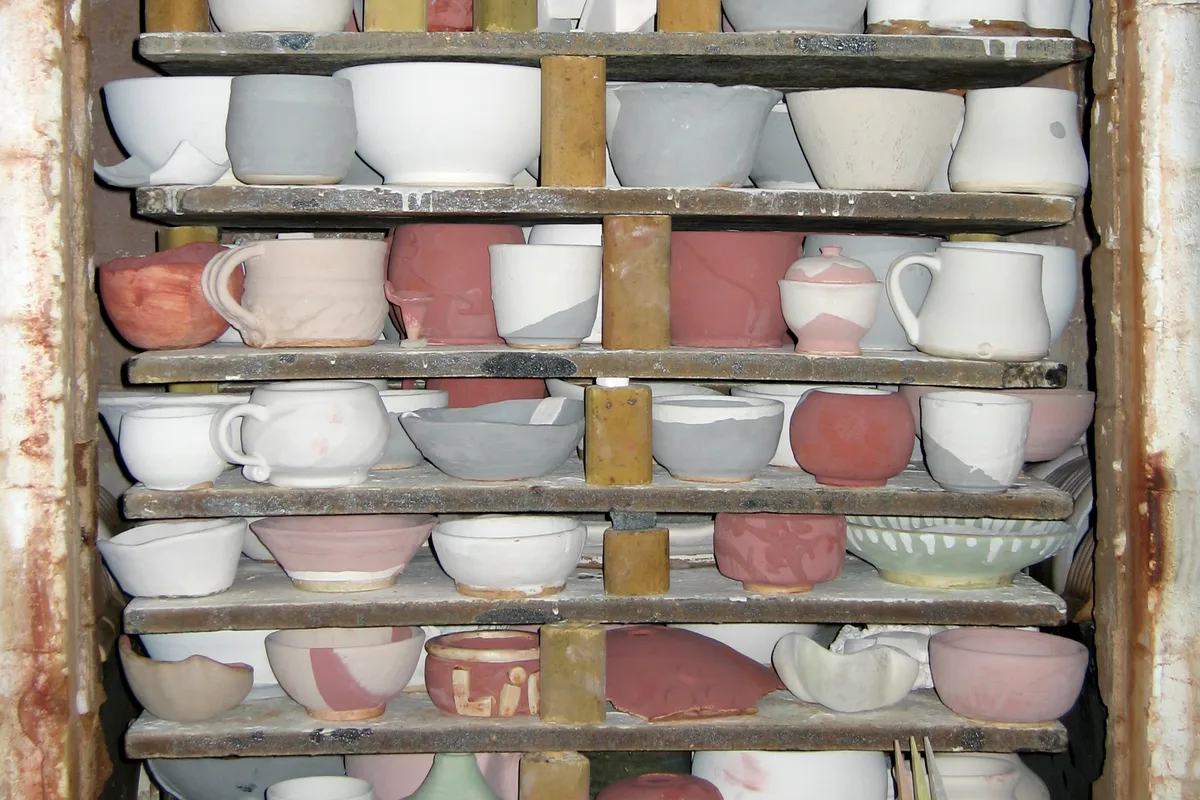
Pottery firing is the stage in which heat turns dry clay into a ceramic material. Handbuilt pottery commonly goes through two firings. Bisque firing turns dry, unfired clay into a porous, absorbent ceramic body that no longer breaks down in water and can be glazed. Glaze firing develops the glassy coating while the clay body continues to change. The right firing schedule does not come from a generic table: it comes from the documentation of the clay and the glaze, the kiln manual and the person who runs the kiln.
This article is part of the pottery without a wheel guide series. Applying glaze is covered in how to glaze pottery for beginners; here the subject is what happens in the kiln and how to follow it without operating the equipment. The main route is the electric kiln, including when the firing is done by a studio or firing service.
Bisque firing and glaze firing: two different questions
What is the difference between bisque and glaze firing?
The bisque firing turns the raw piece into a ceramic body that no longer breaks down in water. The question at this stage is not only “is it hard?”: the absorbency of the bisque governs how much water and glaze it draws in during application. The right condition comes from the clay and glaze documentation and from the recorded experience of whoever fires, not from a single number for every clay.
The glaze firing develops the coating and keeps transforming the body. Neither proves the other: a glaze that looks melted does not guarantee that the clay reached the intended condition, and a mature clay body does not guarantee glaze adhesion or durability. If the clay and the glaze state incompatible firing ranges, the answer is not to pick the average.
Can you fire only once (single firing)?
Single firing exists: the finish is applied to raw clay and the piece goes through the kiln once. It changes handling, drying, application and the release of gases, and it needs materials made for it. Mayco’s Stroke & Coat line, for example, can be applied to raw clay under its own instructions — that does not carry over to any glaze. Do not convert a two-firing system into one just to save energy.
Are cone 06 and cone 6 the same?
No, and the difference is large. In Orton numbering, the leading zero works like a minus sign: cone 022 is the lowest of the zero series and 01 is the highest; cone 1 comes next. So 05 comes before 04, which comes before 03. Always write the zero when you ask for a firing: “six” in a message does not say which one you mean.
What “firing to maturity” means
Maturing is not reaching the highest temperature the kiln can handle. For a given clay body and use, you are looking for a set of properties — shrinkage, absorption, shape stability, mechanical behavior. The supplier’s range guides the choice; the real piece still needs to be checked. Color, ring when tapped and gloss are observations, not tests.
Keep three levels apart in your records: what the manufacturer states; what the test piece showed; whether the piece was accepted for its intended use. One line does not replace the others.
Does firing hotter fix it?
Not as a rule. More heat can change porosity, flow and deformation, but it is not a general correction, and you cannot count on another firing to straighten a warped platter. Any refire is a new technical decision, with risk for the piece and for the load.
Is a piece that does not leak food safe?
No. A pot that did not leak during a quick check is not qualified for food, the dishwasher, the microwave, thermal shock or a flame. Those claims need their own criteria and tests — the glazing article covers food contact.
Temperature does not tell the whole story
The thermocouple measures the temperature in its own area and sends the signal to the controller, which runs the program. It does not measure each piece. Position in the load, geometry and kiln behavior all affect the reading.
What transforms the ceramic is heatwork: the combined effect of time and temperature. Two firings with the same peak temperature can give different results depending on the ramp and the hold. Orton explains that the temperature at which a cone bends depends on the heating rate. Cooling can also change the result, especially with certain glazes, but the final shape of a cone cannot be used to reconstruct the cooling curve. Heatwork is not “temperature times hours”, nor the area under the curve.
- A ramp is a rate of change, in degrees per hour. Careful when converting: 60 °C/h equals 108 °F/h, because for a rate you only multiply by 1.8; the “+32” applies when converting a temperature, not a change. This is a units example, not a recommended ramp.
- A hold (soak) is time spent at a programmed target; record its duration.
- The program is the intention; the recorded curve is what the system observed. If there is no continuous log, write “spot readings” and do not draw a curve between them.
What temperature should you fire pottery to?
There is no single temperature. The firing condition comes from the clay and glaze documentation, which may give temperatures in degrees, pyrometric cones or both. When the reference is a cone, the equivalent temperature depends on the heating rate, and Orton’s chart shows that variation. So you ask for a firing by the documented condition of the materials, and the person responsible for the kiln chooses the program.
How long does a pottery firing take?
There is no universal duration either: it depends on the program, the load, the kiln and the cooling, which is part of the firing. Ask the person responsible when the load will be released instead of working it out from another firing.
Pyrometric cones: what they tell you
A pyrometric cone is a calibrated ceramic piece that softens and bends according to the heatwork it receives. Orton makes small, bar, large and self-supporting cones. Small cones and bars are mainly used in the kiln’s mechanical shut-off (the Kiln Sitter); according to Orton, the only true measurement of heatwork is a large or self-supporting cone placed on the shelf next to the ware. It records the response of its own surroundings — it does not replace the controller’s sensor, nor is it replaced by it.
In a set of three, each cone has a role:
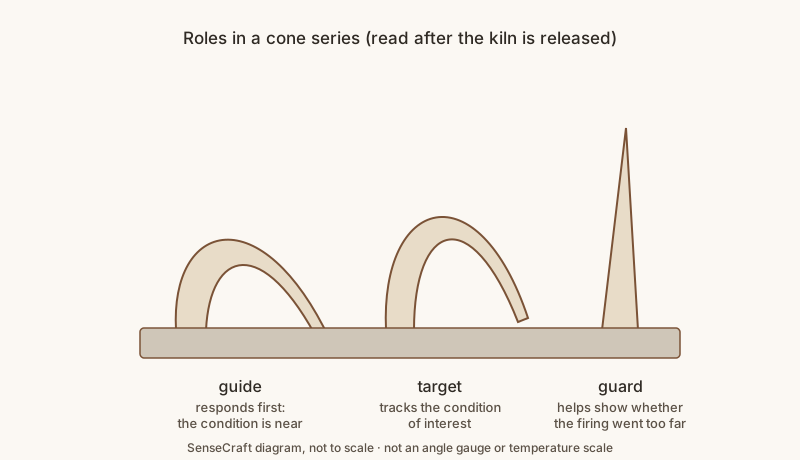
SenseCraft teaching diagram based on chapter 25 of Ceramics by Hand, not to scale. The silhouettes only show the order of response; they are not an angle gauge or a temperature scale.
- Guide: starts to deform first and shows that the condition is near.
- Target (also called the firing cone): tracks the condition of interest; Orton describes a properly fired cone as bent over with its tip almost touching the shelf.
- Guard: helps you recognize when the firing went too far.
The series is chosen from the documentation of the clay, the glaze and the cones themselves — not by sorting the numbers as text. Self-supporting cones reduce variation in height and angle when setting them, but they still follow the manufacturer’s instructions.
How do you read a cone after firing?
Only after the person responsible releases the kiln for opening. Photograph the set with the shelf level identified and write three lines: what the cone shows (bent, fell over, stayed upright); where it was on the load map; what this evidence does not let you conclude. If you wrote “the piece is ready to use” or “every piece received the same heat”, rewrite it: a cone does not certify internal dryness, glaze fit, absence of cracks or an even load.
When cone and display seem to disagree, first check identification, setting, position, program and history. Calibration belongs to the equipment’s procedure and to a qualified person.
Before sending pottery for firing
A dry surface, a hole in a hollow form or days of waiting do not prove that the inside has lost its water. Water trapped in a thick wall can turn to steam during heating. Bring your drying history and leave the decision to the person who runs the kiln.
Intake sheet, one per piece or per group of the same material:
| Field | What to record |
|---|---|
| Identification | Piece ID, clay body (name, code, batch) and stated firing range |
| History | Drying, water added later (touch-ups), storage and transport |
| Geometry | Known thicknesses, hollow parts, areas you cannot inspect |
| Inspection | Cracks, repairs, contamination on the foot, with dated photos |
| Foreign materials | Labels, plastic, plaster, wood, metal, paper or fibers: remove or declare |
| Finish | Glaze (name, code, batch), application done and unglazed band at the foot |
| Decision | Accepted, held until clarified or refused — with who decided and why |
SenseCraft table based on chapter 25 of the book. Write “not known” when that is the case: a field filled in by guesswork weakens the sheet.
A delivery deadline does not replace this assessment. Plaster, plastic and wood do not become suitable just because they fit in the chamber; Skutt warns against unknown and combustible items in the kiln.
How the load is set
A kiln load is a mechanical and thermal arrangement. Whoever loads it draws a map for each level with the IDs of the pieces, shelves, posts and cones; if a piece moves, the map changes before the firing starts. Shelves and posts must suit the kiln and the weight; no improvised shims made from raw pieces or broken shards.
Can pieces touch each other in the kiln?
In a glaze firing, no: the melted coating sticks to the neighboring piece and to the kiln furniture. L&L advises leaving space between glazed pieces and keeping the tallest piece clear of the lid. In a bisque firing, unglazed pieces may touch, but that does not mean you can stack everything: weight, shape, shrinkage and stability still matter. Agree on it with the operator.
Ventilation and safety
An electric kiln has no flame, but heated materials release emissions and the room heats up. Kiln venting and room ventilation are different things, and a household fan pointed at the door does not prove exposure control. If the planned ventilation is not working, the answer is to stop.
The controller does not replace safety devices or the supervision the manufacturer requires, as the Skutt manual points out. The kiln case gets hot enough to burn, and opening the lid exposes you to intense heat: do not lean your face over the lid or look inside as an informal check. If an alarm sounds, power fails, or unusual smells or smoke appear, follow the procedures established by the kiln manufacturer and the facility. The kiln operator must determine how to proceed. Do not simply restart: the load has already received a partial thermal history.
Cooling is part of the firing
The end of heating is not clearance to open. Clay, glaze and kiln furniture are still at different temperatures. Cooling also changes the result of certain glazes: AMACO states that its Cosmos line fires in a normal schedule with no special cooling, and that controlled cooling increases crystal growth — data for that line, not a general rule.
When can you open the kiln?
When the equipment manual and the person responsible clear it. There is no universally safe temperature for opening a kiln, and one manufacturer’s figure does not transfer to another kiln. Opening early, blowing air or using water to meet a deadline puts pieces and kiln furniture at risk.
After the firing: observe, form a hypothesis, decide
Compare each piece with the intake photos and record whether the sign already existed, appeared now, or cannot be compared.
| Layer | Example |
|---|---|
| Observation | “Crack at the root of the handle after the bisque firing.” |
| Hypothesis | “The joint got too much water” or “the firing was fast” — both depend on the history. |
| Decision | Move on to glazing, hold for assessment, keep as a test piece or remake. |
SenseCraft teaching example. A decision to hold a piece may come before the cause is known.
Glaze can hide a crack, but that does not restore the piece’s integrity; another firing is not a guaranteed repair either. To measure, use the same plane and instrument before and after; on an oval platter, record two axes.
How much does a piece shrink in each firing?
It depends on the clay body: the manufacturer’s sheet or your own test bar tells you. The calculation, in the book’s hypothetical example: a bar measuring 100.0 mm dry (DRY), 98.0 mm after bisque and 94.5 mm after the glaze firing (FIRED). Dry to bisque: 2.0%. Bisque to glaze: 3.5 ÷ 98.0 = 3.57%. Dry to final: 5.5% — not 2.0 + 3.57 = 5.57%, because the bases are different. The calculation does not give the wet size, which depends on drying shrinkage.
How to talk to a studio that fires your work
Before making a family of pieces, ask what the service accepts: clay bodies, dimensions, weight, embedded materials, glazes, documentation and turnaround. A useful message:
“Pieces A01 to A06 use the clay body on the attached sheet. Two have a thicker base, flagged in the history. They are not glazed yet. Will you accept this geometry for bisque? What condition do you recommend for the planned glaze, and which records can you send back?”
Ask for whatever they have: photographed cones, the load map, times. If the service only reports the nominal target, scale back your conclusion — do not write “even firing proven”. A refusal because of an unknown clay or a damp piece is process information, not an invitation to hide the problem somewhere else.
How much energy does a firing use?
Read the meter, not the nameplate. In the book’s example, 18.0 kWh over 7.5 h corresponds to an average power of 2.4 kW; multiplying the nameplate power by the time assumes the kiln was on the whole time and may not represent the cycle. Energy does not measure maturity, and the cost of a firing includes more than electricity: maintenance, kiln furniture, labor and losses.
Where this content comes from
This article summarizes chapter 25 of Ceramics by Hand — Foundations and Techniques Without a Wheel, a literature-based guide compiled by SenseCraft. It combines guidance from kiln, cone and glaze manufacturers cited in the sources below with teaching organization, sheets, tables and a diagram developed by SenseCraft. The writing was supported by AI tools and edited by SenseCraft. To see firing in the context of all the techniques, go back to the pottery without a wheel guide.
Sources cited
- Orton Ceramic Foundation. Pyrometric Cones FAQ (cone types, heatwork, heating rate and numbering), How Cones Work and Orton Pyrometric Cones In Action, 2022.
- Skutt. KilnMaster Operating Manual, 2020 (PDF), supervision and items that do not go in the kiln; KilnMaster Manuals, manuals by model.
- Skutt. EnviroVent 2 Operating Manual, 2019 (PDF), kiln venting.
- L&L Kiln. How do I load my kiln properly? and Control Error Codes.
- AMACO. Cosmos Crystalline Glazes, cooling and crystal growth in that line.
- Mayco. Stroke & Coat, application to raw clay in that line.
Cover image: Filled-kiln.jpg, photo by Charles Haynes (Flickr) on Wikimedia Commons, CC BY-SA 2.0 license. Cropped and resized by SenseCraft; the cropped version is shared under the same license.

Limits
- This article is a synthesis of published sources, not the result of SenseCraft testing. The calculations in the text are worked examples with hypothetical values, not rules.
- No firing curve, ramp, hold, temperature for opening the kiln or cone applies to every clay body and every glaze: the documentation of the materials, the kiln manual and the person who runs the kiln decide.
- This text does not teach how to install, program or repair a kiln. A well-bent cone and an attractive glaze do not prove that a piece is food safe, microwave safe or dishwasher safe.
Basis: literature review — original article based on the October 2026 Portuguese edition of the SenseCraft handbuilding book, chapter 25. The corresponding material is also available in English in Ceramics by Hand — Foundations and Techniques Without a Wheel (November 2026 edition), with primary sources listed at the end.