
There is no “best” clay for pottery: there is a clay body that suits a piece, a technique and a firing. Terracotta, earthenware, stoneware and porcelain are families with different typical behavior, but the name alone does not guarantee a temperature, absorption or strength. The choice starts with the piece you want to make and ends with a sample fired in the kiln you will actually use.
This article is part of the series built around the guide to pottery without a wheel. It covers choosing, receiving and storing a clay body; the states clay goes through while you work are covered in leather-hard clay.
Clay and clay body are not the same thing
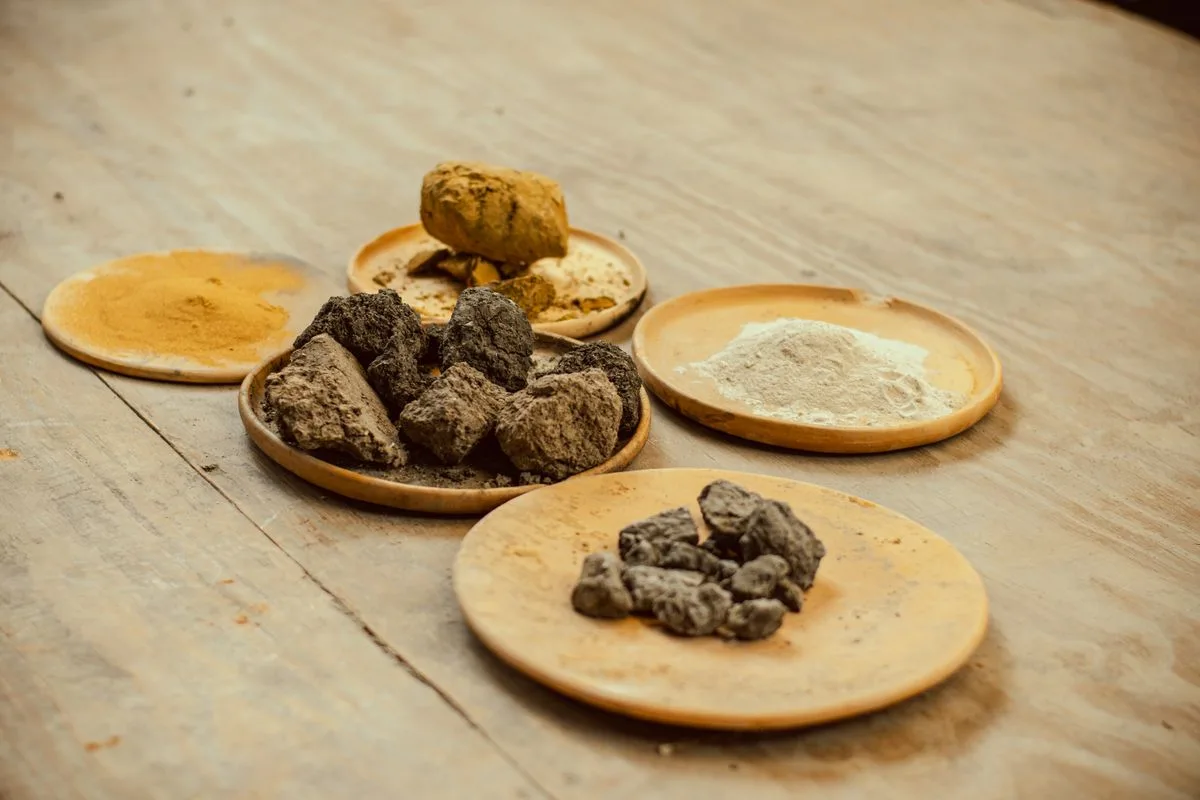
Clay can mean a mineral raw material, like the ones in the photo above. A clay body is a material prepared for forming, which may combine several clays, minerals and additions. The ready-to-use block you buy is part of a defined product and processing system, with a firing range and properties declared by the manufacturer.
That is why adding water to an unknown raw material does not turn it into an equivalent of that block. The useful question is not “is this clay?” but “do I know what this material is, can I prepare it evenly, and do I have enough evidence for the use I have in mind?”
Plasticity is not the same as softness
In ceramics, plasticity describes a clay body’s ability to be deformed without breaking and to keep, to some extent, the shape it was given; how you measure it depends on the method. Consistency is the state you observe during an operation: softer or stiffer. A softer clay body is not necessarily more plastic. In a study published in Materials Research, Andrade, Al-Qureshi and Hotza found a correlation between compressive stress and moisture within each clay studied, but not between different clays with similar water contents. The result applies to those clays and that method; it does not define an ideal water content for the studio.
Types of clay for pottery: what each name tells you
Family names help you filter the catalog. None of them replaces the product data sheet, and there is no universal ranking of quality among them.
| Family | What the name usually indicates | What the name does not guarantee |
|---|---|---|
| Terracotta | Reddish or orange color after firing, often in a porous body | A temperature, a final color or suitability for outdoor use |
| Earthenware and light-colored low-fire bodies | Distinct products, usually formulated for lower firing ranges; the exact range depends on the body | That two products with the same name behave the same way |
| Stoneware | Bodies designed to develop their properties within their own firing range | Low absorption on the schedule you have available |
| Porcelain | Usually light in color and fine-grained; translucency possible under the right conditions | Ease of hand-building or translucency at any thickness |
| Sculpture body, refractory body | An intended use | The specification: it still has to be read on the data sheet |
SenseCraft table based on chapter 2 of the book. The names are starting points for your search, not specifications.
Does the color of the wet block tell you the fired color?
No. Wet color, dry color and fired color are separate records, and the wet color does not identify the composition. Kiln atmosphere, temperature, heatwork, thickness and finish can all change the final look. Keep the label and an identified sample: a photo of the block without product, batch and condition does not replace that information.
What is grog and what is it for?
Grog is ceramic material that has already been fired, crushed and graded, then added to the clay body. Percentage and particle size are separate pieces of information: two bodies with the same grog content can differ in texture, cutting and joining behavior. Linda Arbuckle, in her handout Clays and Clay Bodies, describes the role of non-plastic additions and the different demands of each forming process. Use this to ask questions, not to conclude that more grog always prevents cracks.
As a first filter, the book suggests comparing the grog particle size with the thinnest wall of the piece: a particle that is large relative to the wall can mark an edge or interrupt a detail. When that happens, it is easier to control the result by testing a finer-grained body than by picking grains out one by one, which leaves pits. And do not make grog by crushing dry shards on the bench.
How to choose a clay body for your piece
Before you open any catalog, write a short description: technique, dimensions, thinnest wall, widest span, joined parts, finish and use. Add the kiln or firing service, the schedule available and the glazes you plan to use. For a first project, an identified commercial clay body recommended for hand-building reduces the number of variables you have to investigate.
What is the best clay for beginners?
No single family is best for every beginner. What usually makes the start easier is an identified commercial clay body, with a technical data sheet and an SDS, recommended by the manufacturer for hand-building and with a firing range that matches the kiln or firing service you will use. Princeton’s safety guidance also recommends using premixed clay, so you are not exposed to large quantities of dust while preparing it.
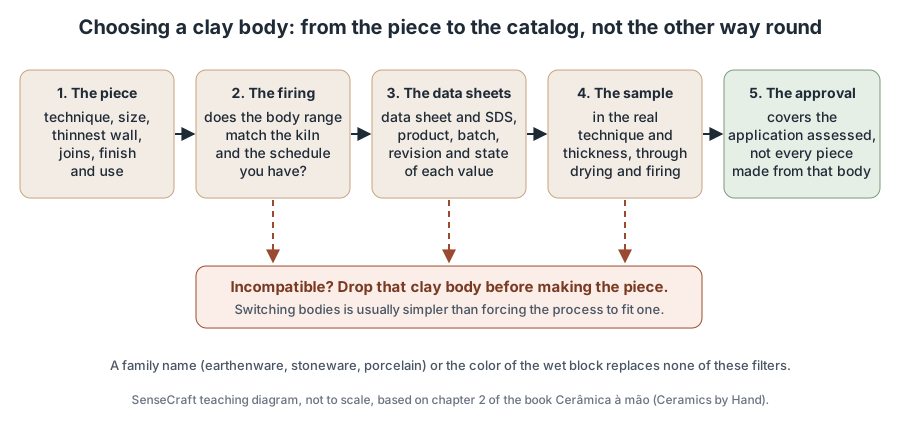
SenseCraft teaching diagram based on chapter 2 of the book Ceramics by Hand, not to scale. An incompatibility at any filter ends the assessment of that clay body.
Which clay works for each hand-building technique?
| Technique | What to look for in the clay body | Representative test |
|---|---|---|
| Pinch | Cohesion when the wall is squeezed, and a comfortable rim | Open a small form and check for cracks, thickness and support |
| Coil | Coils that bend and take the compression of the join | Bend and join coils; follow the seam through drying and firing |
| Slab | Rolling, cutting, holding its shape and finishing without trouble | Make a slab at the planned thickness; cut, lift and join it |
| Press molding with plastic clay | Conforming to the mold, releasing cleanly and withstanding handling | Test a section that reproduces the mold curvature and the actual release step |
| Sculpture | Supporting and joining sections; manageable drying | Build a section with a change in thickness and similar support |
SenseCraft table based on chapter 2 of the book. A test only covers the difficulty it reproduces: a small section does not, on its own, stand for a large piece.
Scale changes the decision. A short strip can hold itself up while a long wall of the same thickness sags. Look for a sample that reproduces the main difficulty of the piece (the span, the join, the curve, the release) and only commit more material once you understand that result. Remember, too, that a body sold for slip casting in plaster molds is not automatically a hand-building body.
Does the firing range have to match my kiln?
Yes, and it is one of the first questions to ask. The firing range is the range the manufacturer declares for the body to develop its intended behavior; it does not mean every property stays the same from one end to the other. Below the right condition, the body may remain very porous; above it, it may deform or develop defects. A glaze does not make up for a clay body that does not suit the schedule.
Temperature is not the whole story: the combined effect of time and temperature is called heatwork. Orton, a maker of pyrometric cones, defines heatwork and explains that large or self-supporting cones placed next to the ware show the heatwork received at that spot in the load. A cone does not identify the clay body or establish that it is suitable for the intended use. Combine the data sheet, the firing record and fired samples, together with whoever is responsible for the firing.
Can I use clay dug from my backyard?
A raw material of unknown origin needs investigating before it becomes a piece. You do not know its composition, its impurities or its firing range, and water does not fix that. The book advises against heating unknown scraps or materials “to see what happens”. To start, a commercial clay body with a technical data sheet and an SDS is the option with the fewest unknowns.
Is pottery clay safe for mugs, plates and food?
The clay body is only part of the answer. It is the whole system (body, slip if any, glaze and firing) that has to be assessed, and the finished piece, not the raw material. Water absorption tells you part of how the fired body behaves, but on its own it does not describe strength, glaze fit, thermal shock or chemical release. The FDA, the US Food and Drug Administration, reports cases of traditional pottery with leachable lead and explains that lead in glazes or decorations can migrate into food and drink when the piece is not properly made. A glassy appearance or low water absorption, by themselves, do not show that the finished piece meets food-contact requirements. Princeton’s safety guidance notes that a “lead-safe” glaze label assumes the ware is fired properly, which is hard to control in a craft studio. For tableware, the book recommends defining the applicable requirements with the supplier and a competent laboratory.
How to read a clay data sheet and SDS
The technical data sheet (sometimes called a product data sheet or specification sheet) describes the product’s properties and conditions. The SDS (safety data sheet, formerly MSDS) covers hazards, handling and emergency response. One does not replace the other. Keep the revision and date of both, the commercial code and the packaging you received.
| Data sheet field | What has to come with the number | Useful question |
|---|---|---|
| Firing | Schedule, atmosphere, cone or thermal reference | Does the range match the firing available and the use? |
| Plasticity | Method and identification of the material | Is it a lab index, a sales description or a local comparison? |
| Grog | Amount, type and particle sizes | Does the texture suit the thinnest wall and the finish? |
| Shrinkage | Starting and ending states and method | Is it drying, firing from dry, or total? |
| Absorption | Method and firing condition | Does the number allow the comparison I want to make? |
SenseCraft table based on chapter 2 of the book.
A real example helps. The product page for PT/CHF grogged terracotta, from the Spanish manufacturer SIO-2, checked on 2 November 2026, declares 25% grog of 0 to 0.5 mm, a firing range of 1020 to 1085 °C, drying shrinkage of 7.2% and water absorption of 16.2% at 1050 °C. A note warns that the color samples may show temperatures outside the recommended range and that the cone equivalence follows the Orton chart under a specific heating condition. The useful lesson is not to transfer these numbers to another clay body: it is to keep the product, revision, state and temperature of each line, and to separate measured data, sales recommendation and what your studio still needs to check.
In the SDS, start with identification and intended uses; then hazards, composition, handling, storage and exposure controls. Check whether the document describes the moist clay, the powder or another state. The classification of the moist product does not show that every operation with the dry material is safe: the absence of a pictogram is not permission to sand, grind or dry-sweep.
Receiving, storing and labeling clay
When it arrives, check product, code and quantity against the order and record supplier, batch, date and data sheet revision. Inspect packaging, seal and any localized hardening. Before using a new batch, cut a portion and compare the surface with the center: look for firmer areas, free water, hard cores and inclusions.
How do you store opened clay?
Seal it well in suitable packaging, store it where the bag will not be punctured, and protect it from uneven water loss; avoid localized heat and any conditions the manufacturer rules out, such as freezing when it says so. There is no universal shelf life for opened clay: the product, seal, additives and storage history should guide reassessment. Write on the side of the container, not only on the lid, the product, batch, date and state (“ready to use”, “being reclaimed”, “awaiting check”).
Can you reuse clay scraps?
Clean, unfired scraps of known origin can be reclaimed, provided they are kept separate by clay body from the start. In his description of his studio practice, potter Joe Thompson distinguishes between still-plastic scraps, dry clay and slurry, and that separation avoids unnecessary steps. Fired ware does not become clay again with water alone. Scraps with glaze, plaster, plastic or uncertain origin stay out of the clean stream. The protocol proposed in the book adds one step: keep the reclaimed clay labeled and make a check piece, compared with new clay, before returning it to regular use.
Safety while preparing clay
Fundacentro, a Brazilian research institution specializing in occupational safety and health, identifies respirable crystalline silica dust as the cause of silicosis, a disease that can be prevented by controlling exposure. In practice, that starts at the bench: collect trimmings where they fall, keep containers covered and wipe up splashes before they dry. Princeton’s guidance recommends wet cleaning of floors and surfaces, so dry scraps do not turn into dust, and warns that pulverizing dry clay and sanding greenware can create very high concentrations of silica dust. The HSE (the UK Health and Safety Executive) guide CR2 calls for wet cleaning or vacuum equipment that meets at least dust class M, and advises against brushes and compressed air for removing dust from surfaces and clothing; an ordinary household vacuum without that rating should not be treated as a silica control. The book adds one studio rule: do not use kitchen utensils that will go back to food, and keep food out of the work area.
Where this content comes from
This article summarizes chapter 2 of the book Ceramics by Hand — Foundations and Techniques Without a Wheel, a literature review organized by SenseCraft. It combines practices, studies and manufacturer documents cited in the sources below with teaching structure, tables, decision filters and studio protocols developed by SenseCraft; when a recommendation comes from the book rather than from a source, the text says so. Writing was supported by AI tools and editorial review by SenseCraft. To see clay selection in the context of all the techniques, go back to the guide to pottery without a wheel.
Sources cited
- Fernando A. Andrade, Hazim A. Al-Qureshi and Dachamir Hotza. Measuring and Modeling the Plasticity of Clays, Materials Research, vol. 13, no. 3, 2010.
- Linda Arbuckle. Clays and Clay Bodies, handout (PDF).
- Edward Orton Jr. Ceramic Foundation. How Pyrometric Cones Work.
- SIO-2. PT/CHF grogged terracotta 0-0.5 mm, product page with technical data.
- US Food and Drug Administration. Questions and Answers on Lead-Glazed Traditional Pottery.
- Princeton University, Environmental Health and Safety. Ceramics, safety guidance.
- Health and Safety Executive. CR2: Casting, silica control guidance (PDF).
- Joe Thompson, Old Forge Creations. How To Reclaim Clay.
- Fundacentro. Sílica e silicose (in Portuguese).
Limits
- This article summarizes published sources; it is not the result of SenseCraft testing. The product data quoted come from the manufacturer and serve only as a reading example.
- No family name (earthenware, stoneware, porcelain) guarantees a temperature, absorption or strength: the product data sheet and a sample fired on your actual schedule are what determine suitability.
- A glassy appearance, low water absorption or a glaze label does not prove that a piece is suitable for food contact.
Basis: literature review — original article based on the October 2026 Portuguese edition of the SenseCraft handbuilding book, chapter 2. The corresponding material is also available in English in Ceramics by Hand — Foundations and Techniques Without a Wheel (November 2026 edition), with primary sources listed at the end.